nE2-4950 Industrial MiniPCIe Wi-Fi 4 Module (4.9 GHz, 2×2 MIMO)
Industrial MiniPCIe Wi-Fi 4 Module for Embedded & Public Safety Systems
The nE2-4950 Wi-Fi 4 MiniPCIe module is a 2×2 MIMO wireless radio designed for OEM and embedded systems requiring operation in the 4.9 GHz and 5 GHz frequency range. With operating channels from approximately 4920 MHz to 5825 MHz, MiniPCIe integration and support for 5, 10, 20 and 40 MHz channel bandwidths, the module can be evaluated for industrial gateways, embedded controllers, public-safety communication equipment and other specialized wireless platforms.
As part of Vizmonet’s Wi-Fi transceiver module portfolio, the nE2-4950 supports IEEE 802.11 a/n operation with a 2×2 MIMO architecture, dual MMCX antenna interfaces and an industrial operating-temperature range of -40°C to +85°C. The module is designed for OEM platforms where RF performance, narrow-channel flexibility, antenna integration and operation across 4.9/5 GHz spectrum need to be considered together.
For public-safety and other specialized 4.9 GHz applications, frequency support is only one part of the design decision. Engineers should also evaluate the required channel width, transmit power at the intended operating mode, receiver sensitivity, antenna architecture, interference environment and the regulatory rules that apply in the deployment country.
Product Highlights
- MiniPCIe form factor (PCI Express 1.1 compliant)
- IEEE 802.11 a/b/g/n compliant
- 2.4 GHz, 4.9 GHz public safety, and 5 GHz UNII bands
- 2×2 MIMO architecture
- Up to 29 dBm transmit power
- Channel bandwidth options: 5 / 10 / 20 / 40 MHz
- Operating temperature: -40°C to +85°C
- Dual MMCX antenna connectors
- OpenWRT compatible (ath9k driver)
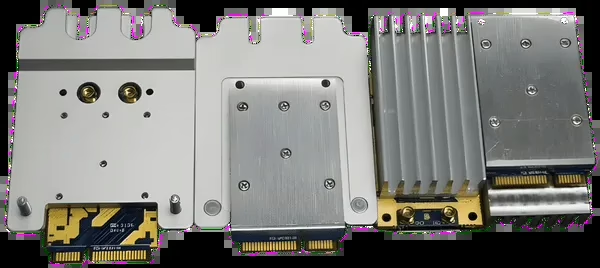
nE2-4950 Wi-Fi 4 MiniPCIe Key Features
IEEE 802.11 a/n
Wifi 4 Transceiver module, complying to 802.11 an standards supporting 2T2R in 4.9 GHz and 5 GHz Bands
OpenWRT support
OpenWRT Linux supported by ath9K wireless driver
Interference Desensitization
Low noise Receiver design integrated with top-tier OBB management provides strong resilience to out-of-band signals, maintaining robust connectivity in the most challenging environments
Best-in Class Receive Sensitivity
Low noise receiver tweaked for optimized Noise Figure offers sharp ears to the OEM systems to maintain reliable connectivity under all circumstances
TX Power of 29 dBm
Highly linear transmitter design with an ultra-high TX power of 29 dBm adhering to strict EVM level exceeding requirements of OFDM modulated signals
Low Latency and High Data Bandwidth
The module offers low latency and high Data Bandwidth, which are crucial for seamless communication and optimal performance. With theoretical maximum speeds of up to 300 Mbps with 64 QAM modulation, it delivers exceptional performance for critical applications
| RADIO MODULE – GENERAL INFO | |
| Chipset | AR 9592-AR1B |
| EEPROM | EEPROM, SERIAL 32KBIT |
| Operating frequency (11b/g/n) | 4920 MHz to 5825 MHz (Operating Channels) |
Data rate-11g (SISO) Data rate-11n (MIMO) Data rate-11n (MIMO) | 6Mbps, 9Mbps, 12Mbps, 24Mbps, 36Mbps, 48Mbps,54Mbps MCS0, MCS1, MCS2, MCS3, MCS4, MCS5, MCS6, MCS7 MCS8.MCS9.MCS10,MCS11,MCS12,MCS13,MCS14,MCS15 |
| Channel BW | 5 MHz/10 MHz/20 MHz/40 MHz |
| RoHS Compliance | Compliant |
| INTERFACE SPECIFICATIONS | |
| Operating Voltage | 3.3V DC |
| RF Antenna connector | x2 MMCX Female (Jack) connector |
| ENVIRONMENTAL SPECIFICATIONS | |
| Operating Temperature Range | -40 deg C to +85 deg C |
| PHYSICAL SPECIFICATIONS | |
| Mechanical Dimension | (L) 58.4 mm x (W) 30 mm x (D) 20.5 mm |
| Weight | TBD |
| REGULATORY INFORMATION | |
| Compliance | TBD |
| PACKAGING INFORMATION | |
| No of units | TBD |
| ORDERING INFORMATION | |
| nE2-4950 | Mini PCIe Radio Module, MIMO, IEEE 802.11 a/n , 4.9/5 GHz 29 dBm |
| Frequency (MHz) | Data rate | TX Power per chain (dBm) | DC Power Consumption (W) | RX Sensitivity (dBm) |
| 4920 TO 4990 | 6 Mbps | 23 | 5.5 | -94 |
| MCS0-HT20 | 26 | 6.5 | -92 | |
| MCS0-HT40 | 26 | 6.5 | -89 | |
| 5180 TO 5320 | 6 Mbps | 24 | 5.8 | -94 |
| MCS0-HT20 | 26 | 6.5 | -92 | |
| MCS0-HT40 | 26 | 6.5 | -89 | |
| 5500 TO 5720 | 6 Mbps | 26 | 6.5 | -94 |
| MCS0-HT20 | 26 | 6.5 | -92 | |
| MCS0-HT40 | 26 | 6.5 | -89 | |
| 5745 TO 5825 | 6 Mbps | 26 | 6.5 | -91 |
| MCS0-HT20 | 26 | 6.5 | -89 | |
| MCS0-HT40 | 26 | 6.5 | -86 |

Frequently Asked Questions About nE2-4950 Wi-Fi 4
What frequency bands does the nE2-4950 Wi-Fi 4 support?
It supports 2.4 GHz, 4.9 GHz public safety, and 5 GHz UNII bands under IEEE 802.11 a/b/g/n standards.
What is the maximum transmit power?
The module delivers up to 29 dBm transmit power for improved coverage.
Is it suitable for industrial environments?
Yes. It operates from -40°C to +85°C and supports rugged deployments.
Does it support OpenWRT?
Yes. It supports OpenWRT using the ath9k wireless driver.

Our Partners