
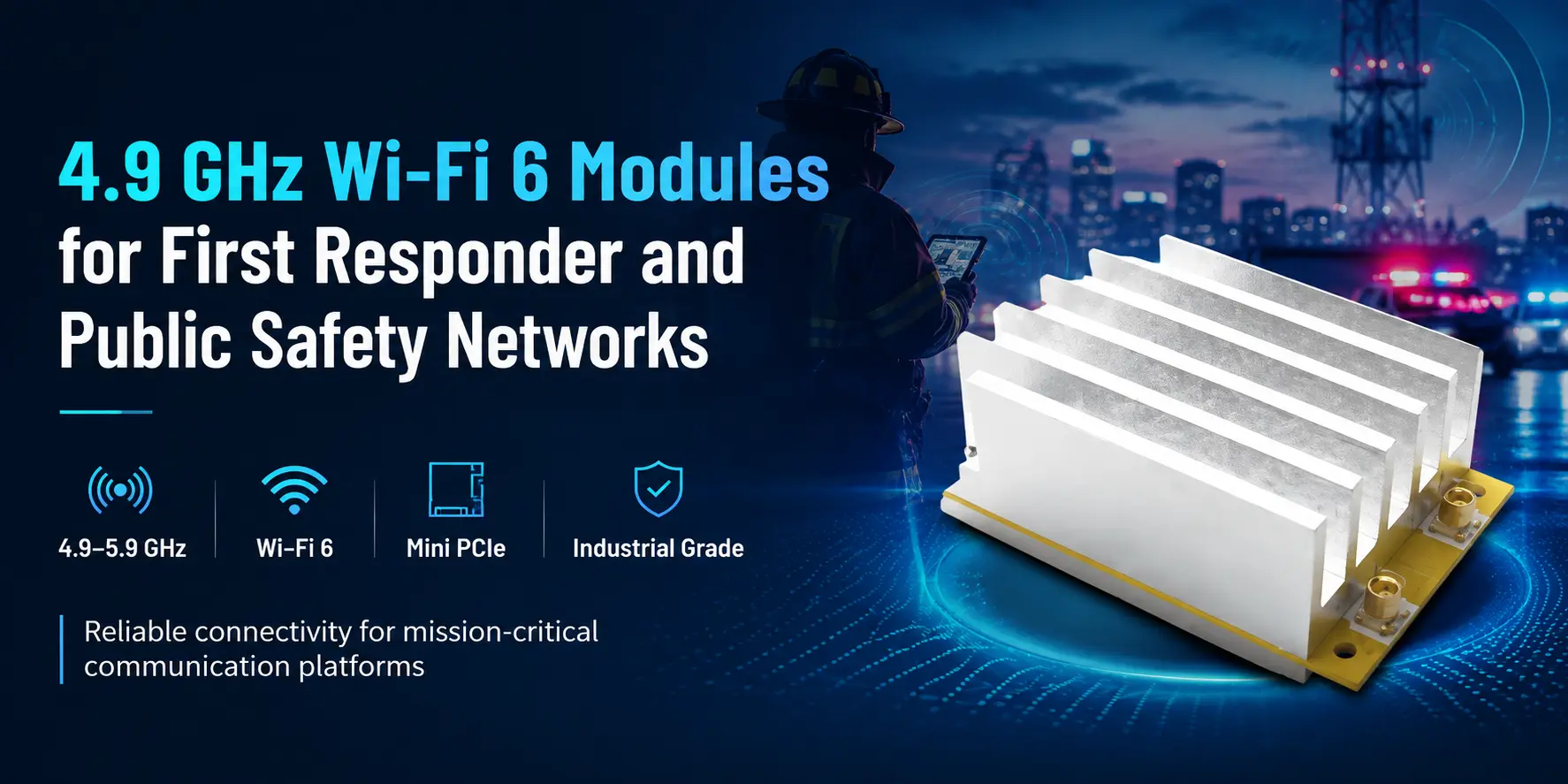
4.9 GHz Wi-Fi 6 Modules for First Responder and Public Safety Networks
When you are designing wireless equipment for first responders, choosing the radio module is not a minor component decision.
It can affect how well the finished system handles interference, whether it fits inside your existing hardware architecture, how much RF engineering you need, and how complicated certification becomes later.
Imagine a vehicle-mounted communication system arriving at an active incident site. Several teams are sharing video, maps and operational data. Other radios are already transmitting nearby. The vehicle is moving, antenna orientation keeps changing, and the equipment may be operating in heat, cold or vibration for hours.
That is a very different environment from an office Wi-Fi network.
For OEMs and system integrators developing equipment for these conditions, a suitable industrial Wi-Fi module needs more than headline throughput. Frequency support, RF performance, software compatibility, temperature range, regulatory requirements and long-term integration support all matter.
The Vizmonet axE2-4950 is a Mini PCIe Wi-Fi 6 module designed for embedded and industrial wireless applications. It supports the 4.9–5.9 GHz frequency range, 2×2 MU-MIMO, PCIe 3.0, OpenWRT and Linux ath11k, with an operating temperature range of -40°C to +85°C.
For a public-safety OEM, though, the specification sheet is only the starting point.
Will this wireless module work inside your actual first responder communication platform, in your target market, under the conditions where the product will be used?
Start With the Mission, Not the Wireless Module
It is tempting to compare Wi-Fi modules by transmit power, throughput and price.
That works reasonably well for commercial networking products. It is not enough for public-safety equipment.
First responder systems may be installed in emergency vehicles, mobile command units, portable gateways, temporary communication nodes or other field equipment. Each platform creates a different RF environment.
Take a vehicle-mounted system as an example. The radio may sit inside an enclosure surrounded by processors, power electronics and other communication equipment. The antennas may be several metres away from the module. Cable loss enters the picture. Vehicle structure can influence antenna performance. Nearby transmitters may raise the noise floor.
Now add movement.
The RF path that looked excellent during a static bench test may behave differently when the vehicle turns a corner, moves behind a building or operates among several other wireless systems.
That is why module selection should begin with your deployment requirements.
Ask what the equipment must actually do.
Does it need to carry multiple video streams? Is it primarily transferring telemetry and operational data? Will dozens of devices be active around the same incident area? Is the product permanently installed in a vehicle or carried into the field?
Those answers should drive your wireless design.
Why 4.9 GHz Can Be Relevant to Public Safety Systems
The 4.9 GHz band has particular relevance to public-safety communication in some regulatory environments.
In the United States, the Federal Communications Commission regulates the 4940–4990 MHz band for public-safety communication applications. The spectrum is subject to specific licensing, coordination and operating requirements.
OEMs developing products for this market can review the FCC guidance on 4.9 GHz public-safety spectrum before finalising their RF architecture.
There is an important distinction here.
4.9 GHz is not universally available public-safety spectrum.
Rules vary by country and region. The organisation permitted to use the spectrum, available channels, allowable transmit power, licensing requirements and certification process may all change depending on where your finished product will be deployed.
For an OEM, that makes the target market an early engineering decision — not something to investigate once the hardware is complete.
Before freezing your RF design, you should already know where the product is going to be sold and who will operate it.
A Specialised Band Does Not Remove Interference Concerns
Operating in specialised spectrum may reduce some of the issues associated with heavily used unlicensed bands, depending on the deployment, but interference does not disappear.
Adjacent-band transmitters still matter. So do other radios installed inside the same platform.
A public-safety vehicle, for example, may contain several communication systems operating simultaneously. Antenna separation, filtering, receiver behaviour and RF coexistence can become just as important as the nominal frequency of the module.
This is where experienced RF engineering starts to make a difference.
What Should You Look for in a Public Safety Wi-Fi Module?
When an OEM approaches Vizmonet looking for a radio module, one specification rarely decides whether the product is suitable.
Several pieces need to fit together.
Frequency Support Must Match the Deployment
If your design requires operation around 4.9 GHz, confirm both sides of the equation:
Can the hardware operate there, and are you authorised to use that configuration in the target market?
The axE2-4950 supports operation across 4.9 GHz to 5.9 GHz, giving OEMs a platform that can be evaluated for specialised 4.9 GHz and 5 GHz applications where regulations permit.
That flexibility is useful, but regulatory limits always take priority over the maximum technical capability of the radio.
Wi-Fi 6 Gives You a Modern Wireless Foundation
The axE2-4950 is built around the Qualcomm QCN9072 platform and supports IEEE 802.11ax / Wi-Fi 6 with 2×2 MU-MIMO.
Why does that matter?
Consider a mobile command platform where several connected systems are exchanging data at the same time. You may have cameras, operator terminals, edge computers and gateways sharing the wireless infrastructure.
The ability to build around a modern Wi-Fi 6 platform gives your engineering team a stronger starting point for applications where network capacity and multiple connected devices matter.
It still does not guarantee performance by itself. Network architecture, channel planning, antennas, software configuration and the surrounding RF environment will determine what you achieve in practice.
Mini PCIe Can Simplify Embedded Integration
A completely new wireless architecture is not always practical.
Many embedded computers, rugged computing platforms and networking systems already use Mini PCIe interfaces. In those cases, a Mini PCIe Wi-Fi module can offer a more straightforward integration path than redesigning the host around an entirely different radio form factor.
The axE2-4950 combines Mini PCIe with PCIe 3.0 connectivity.
But physical fit is only one checkpoint.
You still need to verify available power, thermal behaviour, host compatibility, RF connector placement, antenna routing and mechanical clearance.
Small details here can save weeks later.
RF Power Should Be Viewed as Part of the Link Budget
The axE2-4950 supports transmit power of up to 30 dBm, depending on configuration.
It is an attractive number on a datasheet. It should not be translated directly into a range claim.
Real wireless range depends on the full RF link, including antenna gain, cable loss, receiver performance, channel bandwidth, regulatory EIRP limits, obstacles, interference, modulation rate and fade margin.
For example, increasing radio output power will not solve a badly positioned antenna hidden behind metalwork in a vehicle.
Nor will it fix a receiver being desensitised by another transmitter installed a few centimetres away.
Good RF design looks at the complete system.
Where the Vizmonet axE2-4950 Fits
The axE2-4950 industrial Wi-Fi module is worth considering when your product requirements bring several needs together:
4.9/5 GHz operation, Wi-Fi 6, Mini PCIe integration, industrial temperature capability and an embedded Linux networking environment.
Its individual specifications become more meaningful when translated into engineering decisions.
The 4.9–5.9 GHz frequency range gives you flexibility for products being developed around applicable 4.9 GHz or 5 GHz deployments.
Wi-Fi 6 and 2×2 MU-MIMO provide a modern radio architecture for systems that may need to handle higher data loads or multiple network devices.
The specified -40°C to +85°C operating temperature range is relevant when your hardware is being designed for vehicles, outdoor installations or industrial environments rather than climate-controlled offices.
Support for OpenWRT and the Linux ath11k driver can also be valuable if your product is based on an embedded Linux networking platform.
None of those features should be considered in isolation.
The value comes from whether they fit the product you are actually building.
Think Beyond the Lab: How the Module Could Be Used
A good way to evaluate any industrial Wi-Fi module is to picture it inside the finished equipment.
Not on a development bench. In the field.
Mobile Command and Coordination Systems
A command vehicle may need to connect local computing equipment, cameras or other data systems to a wireless network while teams coordinate an incident.
Here, the wireless module becomes part of a much larger system.
You need to think about where antennas will be installed, what other transmitters are present in the vehicle, what traffic the link must carry and how the network behaves when the vehicle changes position.
Vehicle-Mounted Communication Equipment
Emergency vehicles can expose electronics to vibration and large temperature changes while placing several RF systems close together.
An industrial wireless module with a wider temperature specification gives you a stronger starting point, but the complete design still needs system-level environmental and RF validation.
Portable and Field-Deployed Gateways
Consider a portable communication unit brought into an area where fixed connectivity is limited.
The gateway may need to connect local Ethernet devices or embedded computers to a wireless network while running customised networking software.
Mini PCIe integration together with OpenWRT or Linux support can make this type of architecture particularly relevant for embedded network designers.
Video and Operational Data Links
Video is a useful example because it quickly exposes weak wireless design.
A link may work perfectly when carrying small packets during testing, then struggle once several high-data-rate streams are added.
If your system is expected to transport video, telemetry or operational information, test it under realistic traffic conditions.
Do not qualify the link using an empty network.
For more application-level information, explore Vizmonet’s public safety wireless applications.
Software Support Can Make or Break an Embedded Project
RF specifications receive most of the attention during module selection.
Software often creates the integration schedule.
A radio can meet every frequency and power requirement and still become a poor product choice if your engineering team cannot integrate or maintain the driver stack reliably.
The axE2-4950 supports OpenWRT and Linux ath11k, which makes it relevant to embedded Linux and networking platforms built around these environments.
Before making the final choice, check your exact implementation.
Which kernel version are you using? What firmware dependencies are involved? Who owns long-term software maintenance? Will the same operating system remain in your product for several years?
These questions become particularly important for OEM equipment with a long commercial lifecycle.
Do Not Leave Regulatory Compliance Until the End
One of the more expensive mistakes in wireless product development is treating certification as a final-stage activity.
By then, the PCB may be frozen. The enclosure may be tooled. The antenna location may already be fixed.
And that is exactly when an unexpected compliance issue becomes painful.
The better approach is to build regulatory requirements into product architecture from the beginning.
Vizmonet states that the axE2-4950 has achieved FCC certification. That module-level certification can support an OEM’s regulatory strategy, but it does not automatically certify every finished product that contains the radio.
Your final equipment may still need compliance work depending on its antenna, installation, RF exposure, EMC behaviour, other transmitters, intended market and product configuration.
If the product will be sold internationally, the situation becomes broader again. FCC requirements in the United States are only one part of the picture.
Vizmonet supports OEMs with wireless product certification and testing as well as global regulatory compliance and homologation.
For many product teams, bringing regulatory specialists into the discussion before the prototype is finalised is considerably cheaper than redesigning hardware after a failed test.
From a Radio Module to a Finished Public Safety Product
Buying a wireless module solves one part of the problem.
You still need to make it work inside your product.
This is where the difference between a component supplier and an engineering partner becomes noticeable.
An OEM integrating a radio such as the axE2-4950 may need help with the host interface, antenna system, RF performance, thermal design, embedded software, certification or production.
Sometimes all of them.
RF Integration Needs to Happen at System Level
Suppose the module performs well on its evaluation board.
You move it into the final enclosure and suddenly throughput drops.
What changed?
Perhaps the antenna is too close to metal. Maybe cable loss is higher than expected. Another transmitter may be affecting the receiver. The enclosure itself may have altered the antenna pattern.
These are common system-integration problems. They are also difficult to solve by looking at the module datasheet.
RF engineering can include antenna selection and placement, link-budget analysis, coexistence evaluation, interference investigation and field testing.
The earlier this happens, the more design freedom you still have.
Customisation Matters When Standard Hardware Is Not Enough
Public-safety products are rarely identical.
A portable gateway has different constraints from a vehicle-mounted unit. A mobile communication platform may prioritise RF power and thermal performance, while another product may have tight mechanical limits.
That is why OEM development sometimes needs more than an off-the-shelf module.
Vizmonet’s wireless product development services can support RF design, embedded-system integration, customisation, prototyping, testing and production requirements around the finished application.
Manufacturing Should Be Considered Before the Prototype Is Finished
A prototype only needs to work.
A commercial product needs to work repeatedly.
Once production starts, component availability, assembly, test procedures, quality control and traceability become part of the project.
Design decisions made early can either simplify production or create recurring problems on the manufacturing floor.
For OEMs planning to move from engineering samples into volume production, it makes sense to consider manufacturability during development rather than after it.
Questions to Ask Before You Commit to a 4.9 GHz Radio
If you are evaluating modules today, a useful discussion with your engineering team could begin with a few practical questions.
Where will the product be deployed?
The answer determines the regulatory framework and whether your intended 4.9 GHz configuration is appropriate.
What does the wireless link actually have to carry?
A telemetry link and a multi-camera video system have very different requirements.
What happens when the link gets worse?
Define the minimum acceptable throughput, latency or connection quality instead of designing only for ideal conditions.
What other radios will be nearby?
This matters especially in vehicles and multi-radio embedded systems.
Where can the antennas realistically be installed?
Do this before the enclosure design is locked.
What operating system and driver environment will the product use?
Hardware and software selection should happen together.
Which certifications are needed in every target market?
One approval does not automatically cover a global product.
How long will the equipment remain in production?
Public-safety and industrial platforms can have longer lifecycles than consumer electronics. Product availability and engineering support matter.
If a prospective module supplier cannot have a useful conversation about these questions, you may be evaluating only a component — not a complete development path.
Why OEMs Work With Vizmonet on Industrial Wireless Products
Vizmonet focuses on wireless and embedded products designed for OEM and industrial applications.
That matters when your project needs support beyond purchasing a radio card.
The team works across wireless module integration, RF engineering, system design, prototype development, testing, regulatory support, PCB assembly and product manufacturing.
For an OEM developing a public-safety platform, that means the same project can be approached from several connected angles.
Will the radio provide the required RF capability?
Can it be integrated into the host?
Will the antenna system work inside the mechanical design?
What needs to happen for certification?
And once the design is ready, can it be manufactured consistently?
Those questions are connected. Treating them separately often creates avoidable redesign work.
Explore Vizmonet’s public safety wireless solutions or review its broader wireless engineering services for OEM product development.
Frequently Asked Questions
What is the Vizmonet axE2-4950?
The axE2-4950 is an industrial Mini PCIe Wi-Fi 6 module from Vizmonet based on the Qualcomm QCN9072 platform. It supports the 4.9–5.9 GHz frequency range, 2×2 MU-MIMO, PCIe 3.0, OpenWRT and Linux ath11k, with a specified operating temperature range of -40°C to +85°C.
Does the axE2-4950 Support 4.9 GHz?
Yes. The axE2-4950 supports frequencies from 4.9 GHz to 5.9 GHz.
However, the ability to operate at a particular frequency depends on the regulations that apply in the country and deployment environment. OEMs should confirm spectrum and licensing requirements before finalising the product configuration.
Is Mini PCIe Suitable for Public-Safety Equipment?
It can be.
Mini PCIe is commonly useful in embedded systems where the host already provides a compatible interface and sufficient mechanical space. You should also check power, thermal requirements, antenna connections, RF performance and environmental conditions before selecting the module.
Is the axE2-4950 a Wi-Fi 6 Module?
Yes. The axE2-4950 supports IEEE 802.11ax / Wi-Fi 6 and 2×2 MU-MIMO.
What Should I Check Before Integrating a 4.9 GHz Wi-Fi Module?
Start with the target country and permitted spectrum. Then evaluate the required range and throughput, host interface, antenna design, RF interference, operating temperature, software support, certification path and expected product lifecycle.
The module should be selected as part of the complete system architecture rather than as a standalone radio.
Can Vizmonet Help With Regulatory Compliance?
Yes. Vizmonet provides support for wireless product certification and testing and global regulatory compliance and homologation, including support for geography-specific approval requirements.
Can Vizmonet Support Custom Wireless Product Development?
Yes. Vizmonet’s wireless engineering and product development services cover areas including RF and system design, integration, prototyping, testing, manufacturing and certification support for OEM wireless products.
The Right Module Decision Happens Before the Hardware Is Frozen
If you are building a first responder communication platform, the biggest wireless decisions usually happen much earlier than certification or production.
They happen when you decide the operating frequencies.
When you choose the host architecture.
When you position the antennas.
When you select the wireless module.
And when you decide what the product must still be able to do in a difficult RF environment rather than under ideal test conditions.
For OEMs that require 4.9 GHz capability, Wi-Fi 6, Mini PCIe integration, Linux support and industrial operating temperatures, the Vizmonet axE2-4950 offers a practical platform to evaluate.
But the best way to determine whether it is right for your project is not to compare another datasheet.
Discuss the actual system.
Your target market. Your expected link distance. The antenna constraints. Data requirements. Operating environment. Certification plan. Production volume.
That is where meaningful product selection begins.
Discuss Your Public Safety Wireless Requirement
Developing a mobile command system, vehicle-mounted communication platform, public-safety gateway or another first responder wireless product?
Discuss your RF, integration, regulatory and product-development requirements with the Vizmonet engineering team.