
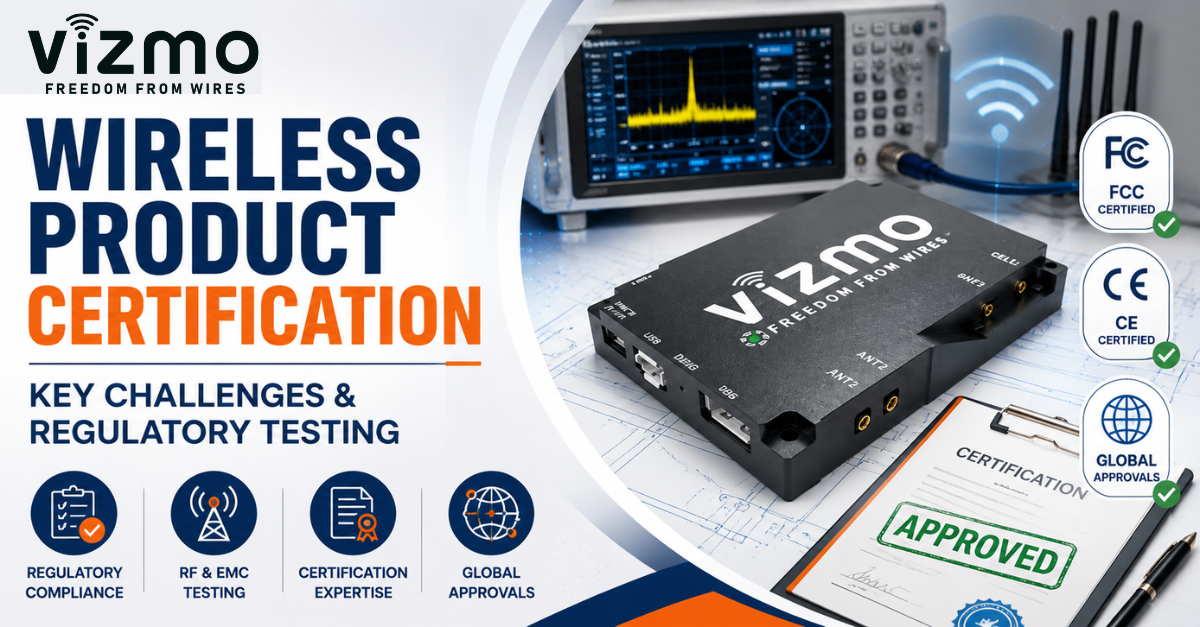
Wireless Product Certification: Testing and Regulatory Challenges
Developing a wireless product involves more than designing hardware and writing software. Before the product can enter a market, it may need to meet radio, electromagnetic compatibility, safety, RF exposure, cybersecurity, labelling and documentation requirements.
Wireless product certification can become one of the most complex stages of product development. A product that performs well in the laboratory may still fail a formal compliance test. A certified radio module may also require additional checks after it is installed inside a finished product.
The approval route can change from one country to another. Frequency bands, transmit-power limits, test standards, labelling rules and documentation requirements may differ. A product approved for one market cannot automatically be sold in every other market.
For OEMs planning international launches, global regulatory compliance and homologation should be considered during the first stages of product design.
This guide explains the main wireless certification and regulatory testing challenges. It also provides practical steps that can reduce avoidable redesigns, testing delays and market-access risks.
Important note: Certification requirements depend on the product, radio technology, operating frequency, intended use and target market. Manufacturers should confirm the current requirements with the relevant regulator, recognised laboratory or qualified compliance specialist.
What Does Wireless Product Certification Cover?
Wireless product certification is a broad term. It can include several separate assessments rather than one universal test or certificate.
Depending on the product and market, the compliance process may cover:
- Radio-frequency emissions
- Operating frequency and channel use
- Transmit-power limits
- Out-of-band and spurious emissions
- Electromagnetic compatibility
- Electrical and product safety
- Human exposure to RF energy
- Cybersecurity and privacy requirements
- Approved antenna configurations
- Software and firmware controls
- Product labels and user information
- Technical-file preparation
- Importer and supplier responsibilities
The exact process may involve certification, registration, self-declaration, conformity assessment, listing or type approval.
A manufacturer should not assume that one approval covers every requirement. Radio, EMC, safety and RF exposure may be assessed under different rules.
Certification, Approval, Registration and CE Marking
Regulatory terms are not always interchangeable.
Certification
Certification normally involves an assessment against defined technical requirements. A recognised body or authority may issue an approval, certificate or grant after reviewing test results and technical documents.
Registration or Listing
Some markets require approved products to be entered into an official database before they can be imported, distributed or sold.
Self-Declaration
Some approval routes allow the manufacturer or responsible supplier to declare compliance. The company must still complete the required assessment and keep supporting evidence.
CE Marking
The phrase “CE certification” is often used informally. However, the more accurate process for European wireless products is conformity assessment under applicable EU legislation, followed by an EU Declaration of Conformity and CE marking.
The EU Radio Equipment Directive covers safety and health, electromagnetic compatibility and efficient use of the radio spectrum. Other requirements may also apply depending on the product.
Common Wireless Product Approval Routes
The following table provides a general overview. It is not a complete market-access assessment.
| Market | Common Regulatory Route | Important Considerations |
|---|---|---|
| United States | FCC equipment authorisation | Radio rules, RF exposure, approved operating conditions, labelling and documentation |
| European Union | Radio Equipment Directive conformity assessment and CE marking | Radio spectrum, EMC, safety, technical file, declaration of conformity and applicable cybersecurity requirements |
| Canada | ISED radio equipment certification | Applicable Radio Standards Specifications, certification and Radio Equipment List requirements |
| India | WPC Equipment Type Approval, where applicable | Frequency band, de-licensed spectrum use, RF test documentation and applicable import or market-access requirements |
| Australia | ACMA supplier compliance process and RCM labelling | Applicable radio, EMC, electromagnetic energy, record-keeping and supplier responsibilities |
For the United States, the FCC equipment authorisation programme requires RF devices to use the correct authorisation procedure before US marketing or import.
In Canada, ISED wireless equipment certification applies to relevant radio equipment before it is imported, distributed or offered for sale.
In India, the WPC Equipment Type Approval process applies to relevant wireless equipment operating in de-licensed bands.
In Australia, suppliers should follow the ACMA product-compliance process. An overseas FCC or CE mark does not automatically prove Australian compliance.
Challenge 1: Different Regional Frequency and Power Rules
Wireless devices do not operate under one worldwide frequency plan.
Differences can include:
- Permitted frequency bands
- Available Wi-Fi channels
- Channel-width limits
- Maximum conducted transmit power
- Maximum effective radiated power
- Duty-cycle limits
- Indoor-only or outdoor restrictions
- Dynamic frequency-selection requirements
- Listen-before-talk requirements
A radio configuration that is permitted in one country may not be allowed in another. This is especially important for Sub-1 GHz, Wi-Fi HaLow, 5 GHz and 6 GHz products.
Best Practice
Identify all target markets before finalising the radio, antenna, power amplifier and frequency plan.
Create a regulatory matrix that includes:
- Country or region
- Permitted bands
- Required test standards
- Power limits
- Antenna restrictions
- Approval route
- Local representative requirements
- Labelling and documentation requirements
This process can help engineers avoid creating a design that is technically difficult to approve in an important market.
Challenge 2: Selecting the Correct Certification Route
One product may fall under several regulatory frameworks.
For example, a connected industrial device may need to address:
- Radio-spectrum compliance
- EMC compliance
- Electrical safety
- RF exposure
- Cybersecurity
- Environmental regulations
- Industry-specific requirements
Selecting the wrong standard or approval route can result in incomplete testing. It may also cause a laboratory to test the wrong operating mode.
Best Practice
Create a product-regulation plan before requesting quotations from test laboratories.
Document:
- Product type
- Intended users
- Installation environment
- Radio technologies
- Power source
- Antenna configuration
- Operating distance from the human body
- Target markets
- Commercial and industrial use cases
Share the same product description with engineering teams, laboratories and certification partners. This reduces the risk of different teams making different assumptions.
Challenge 3: RF Compliance Testing Failures
RF compliance testing checks whether a transmitter operates within the permitted technical limits.
Common failure areas include:
- Excessive transmit power
- Unwanted emissions
- Out-of-band emissions
- Spurious emissions
- Occupied bandwidth
- Frequency instability
- Incorrect channel configuration
- Power-control errors
- Harmonic emissions
Failures may come from the radio chipset, power amplifier, PCB layout, clock, power supply, enclosure, antenna or firmware configuration.
Best Practice
Perform wireless pre-compliance testing before the formal certification campaign.
Test:
- Lowest, middle and highest channels
- Minimum and maximum bandwidths
- Highest transmit-power settings
- All supported modulation modes
- Continuous-transmit or test modes
- Worst-case supply voltage
- High and low operating temperatures where required
- Final antenna and enclosure configurations
Pre-compliance results do not replace formal testing. They help identify risks while design changes are still easier to make.
Challenge 4: EMC Certification and Testing
Electromagnetic compatibility, or EMC, covers two main areas.
- Emissions: The product should not create excessive electromagnetic disturbance.
- Immunity: The product should continue operating correctly when exposed to defined disturbances.
Common EMC problems include:
- Poor PCB grounding
- Insufficient filtering
- Switching power-supply noise
- Fast digital clocks
- Unshielded cables
- Long PCB traces
- Poor connector bonding
- Enclosure leakage
- Electrostatic-discharge sensitivity
EMC certification should not be treated as a final laboratory activity. EMC performance is affected by decisions made during schematic design, PCB layout, cable selection and enclosure design.
Best Practice
Include EMC design reviews during product development.
Useful activities include:
- Reviewing grounding and return-current paths
- Checking switching-regulator layouts
- Testing conducted and radiated emissions
- Reviewing cable and connector shielding
- Using near-field probes to identify noise sources
- Testing the product with its final power supply and accessories
The correct EMC standards depend on the radio technology, product category and intended environment.
Challenge 5: RF Exposure and Product Safety
Wireless devices may need an assessment of human exposure to RF energy.
This is especially important for:
- Wearable products
- Handheld equipment
- Body-mounted devices
- Products used close to workers
- High-power transmitters
- Multi-radio systems
The required assessment may involve specific absorption rate, maximum permissible exposure or an exclusion calculation. The correct method depends on factors such as power, frequency, antenna distance and normal operating position.
The FCC provides separate RF exposure guidance for mobile and portable devices.
Best Practice
Define the intended use position and antenna separation distance early.
Do not wait until certification to decide whether the product is handheld, body-worn, mobile or fixed. A change in installation distance can affect the RF exposure assessment.
For multi-radio products, evaluate whether radios can transmit at the same time. Combined exposure may require a different assessment from testing each radio separately.
Challenge 6: Certified Wireless Module Integration
Using a pre-certified module can reduce part of the certification workload. However, module certification does not automatically approve every finished host product.
The OEM must follow the module’s integration conditions.
These conditions may cover:
- Approved antenna types
- Maximum antenna gain
- Antenna separation distance
- Power-supply requirements
- Host-product labelling
- User-manual statements
- Country-code restrictions
- Co-location with other transmitters
- RF exposure conditions
- Required host EMC testing
FCC guidance explains that transmitter modules and products containing those modules must follow the conditions of the approved configuration. Review the current FCC modular-transmitter guidance before relying on an existing module approval.
Best Practice
Request the complete module integration package before selecting a module.
It should include:
- Certification identifiers
- Applicable test reports
- Integration instructions
- Approved antenna list
- RF exposure conditions
- Labelling instructions
- Software restrictions
- Regional approval status
Use the guide to selecting embedded wireless modules for industrial applications and the wireless module supplier checklist during product planning.
Vizmonet’s experience with FCC certification for Wi-Fi modules also shows why module documentation and approved operating conditions matter during host integration.
Challenge 7: Antenna Changes and Integration
The antenna is part of the certified RF system. Changing the antenna can affect transmit power, radiation pattern, emissions, RF exposure and regulatory compliance.
Common antenna-related risks include:
- Using an antenna with excessive gain
- Changing from an integrated to an external antenna
- Using a different antenna type
- Adding a detachable connector
- Changing the RF cable length
- Poor antenna matching
- Installing the antenna near metal
- Changing the enclosure material
- Using an unapproved MIMO configuration
An antenna that works well in open-air testing may perform differently inside the final enclosure.
Best Practice
Evaluate the complete radio, cable, connector, antenna and enclosure system.
Confirm:
- Frequency coverage
- Maximum antenna gain
- Impedance and matching
- Connector type
- Cable loss
- MIMO antenna arrangement
- RF exposure distance
- Effective radiated power
Read the industrial wireless antenna selection guide before finalising the antenna system.
Challenge 8: Multi-Radio and Coexistence Testing
Modern products may contain several radios, including:
- Wi-Fi
- Bluetooth
- Cellular
- Wi-Fi HaLow
- GNSS receivers
- Proprietary Sub-1 GHz radios
- Near-field communication
Testing each radio separately may not identify every system-level problem.
Multi-radio products can experience:
- Receiver desensitisation
- Intermodulation
- Harmonic interaction
- Shared-clock interference
- Power-supply noise
- Poor antenna isolation
- Combined RF exposure
- Unexpected simultaneous-transmission modes
Best Practice
Create a radio-concurrency matrix showing which transmitters can operate together.
Test the worst-case permitted combinations. Include maximum transmit power, nearby channels, active processors, final antennas and normal host-product operation.
Software should prevent prohibited or untested radio combinations from being enabled in production products.
Challenge 9: Firmware and Software Configuration
Firmware can control important radio parameters, including:
- Country code
- Available channels
- Transmit power
- Channel bandwidth
- Duty cycle
- Modulation mode
- Dynamic frequency selection
- Simultaneous transmission
A product can fail compliance even when the hardware is unchanged if firmware allows an unauthorised channel or power level.
Best Practice
Lock regulatory radio settings so that end users and unauthorised software cannot enable unsupported configurations.
Maintain:
- Approved firmware version records
- Regional configuration tables
- Software change history
- Radio-driver version records
- Test-mode instructions
- Release approval procedures
Evaluate firmware updates for regulatory impact before releasing them.
Challenge 10: Cybersecurity Requirements
Cybersecurity is becoming part of product compliance for many connected wireless products.
Requirements may address:
- Protection of networks
- Secure authentication
- Credential management
- Protection of personal data
- Secure software updates
- Resistance to fraud
- Vulnerability handling
- Product-lifecycle support
The EU Radio Equipment Directive includes additional cybersecurity, privacy and fraud-protection requirements for certain categories of connected radio equipment.
Best Practice
Build security into the product architecture instead of adding it before the final audit.
Document:
- Security requirements
- Threat and risk assessment
- Authentication methods
- Secure-boot and update mechanisms
- Credential storage
- Vulnerability-reporting process
- Support and update period
Do not assume that one cybersecurity standard applies to every product or country. Confirm the requirements for the target market and device category.
Challenge 11: Technical Documentation
Good test results are not enough if the technical documentation is incomplete.
A certification file may need:
- Product description
- Block diagrams
- Schematics
- PCB layouts
- Bill of materials
- Radio specifications
- Antenna details
- Internal and external photographs
- User manual
- Installation instructions
- Label drawings
- Software and firmware information
- Risk assessment
- Test reports
- Declaration of conformity
Missing or inconsistent documents can delay the review process even when the device passes testing.
Best Practice
Create the compliance file throughout development.
Use document control for:
- Revision numbers
- Approval status
- Product variants
- Component changes
- Firmware versions
- Test samples
- Certification reports
The product name, model number, hardware version and firmware version should remain consistent across the label, user manual, test report and application.
Challenge 12: Product Changes and Retesting
Products often change after initial testing.
Changes may include:
- PCB revisions
- Component substitutions
- New power supplies
- Antenna changes
- Enclosure changes
- Firmware updates
- New radio features
- Additional product variants
Not every change requires a completely new approval. However, every change should be assessed for its regulatory impact.
Best Practice
Use formal change control after the design enters certification.
For every proposed change, record:
- What changed
- Why it changed
- Whether RF performance may be affected
- Whether EMC or safety may be affected
- Whether documentation must be updated
- Whether partial or full retesting is needed
- Who approved the regulatory assessment
Avoid unreviewed substitutions during production. A replacement component with the same basic function may still produce different RF or EMC behaviour.
Why Wireless Pre-Compliance Testing Matters
Formal certification laboratories normally test the final product against defined standards. Discovering a major problem at this stage can affect the project schedule.
Wireless pre-compliance testing can help identify:
- RF emissions close to the limit
- EMC noise sources
- Antenna performance problems
- Incorrect radio settings
- RF exposure risks
- Worst-case operating modes
- Documentation gaps
Pre-compliance testing should use hardware, firmware, antennas, cables and accessories that are as close as possible to the final production configuration.
It does not guarantee first-pass certification. It can make the formal test campaign more predictable and provide more time to correct problems.
Post-Certification Responsibilities
Wireless compliance does not end when the certificate or approval is issued.
Manufacturers and responsible suppliers may need to maintain:
- Production consistency
- Approved component control
- Certification records
- Technical documents
- Product labels
- Declarations of conformity
- Importer and distributor information
- Software-update assessments
- Complaint records
- Corrective-action procedures
Regulators may conduct market surveillance, request samples, review technical files or test products taken from the market.
A production unit should remain consistent with the tested and approved design.
When moving from development to volume production, review how turnkey manufacturing, PCB assembly and box build can support controlled product configuration and documentation.
Wireless Product Certification Checklist
Before formal testing begins, confirm that you have:
- Defined all target markets
- Identified the correct approval routes
- Selected the applicable standards
- Confirmed regional frequency and power limits
- Reviewed radio-module certifications
- Confirmed approved antenna types and gain
- Completed RF pre-compliance testing
- Completed EMC pre-compliance testing
- Evaluated RF exposure requirements
- Tested multi-radio operating combinations
- Locked regional firmware settings
- Reviewed cybersecurity requirements
- Prepared the technical file
- Prepared labels and user-manual statements
- Frozen the test-sample configuration
- Created a hardware and software change-control process
- Planned production compliance checks
- Allowed time for failures and retesting
How Vizmonet Supports Wireless Product Certification
Vizmonet supports OEMs developing industrial wireless products, embedded modules and connected equipment for international markets.
Support can include:
- Wireless product architecture
- Radio-module selection
- RF design and optimisation
- Antenna integration
- PCB and embedded-system development
- RF and EMC pre-compliance support
- Certification planning
- Technical-document preparation
- Global homologation support
- Prototype and production transition
OEMs can review Vizmonet’s integrated wireless product development services and wireless engineering services when planning a new connected product.
The industrial RF wireless transceiver module guide also explains important factors to review before selecting radio hardware.
Vizmonet has experience supporting certified wireless products, including the FCC-certified Vizmonet nE1-902 module.
Plan Certification Before Final Product Testing
Successful wireless product certification starts before the product reaches the formal test laboratory.
Manufacturers should identify target markets, select the correct standards, review radio and antenna configurations, evaluate RF exposure, control firmware settings and prepare technical documentation during development.
Pre-compliance testing and formal change control can help reduce avoidable certification risks. Post-market compliance and production consistency must also remain part of the product lifecycle.
There is no single certification route for every wireless product. The correct approach depends on the radio technology, product category, operating environment and countries where the device will be sold.
Frequently Asked Questions
What is wireless product certification?
Wireless product certification is the process of showing that a radio-enabled product meets the technical and regulatory requirements of its target market. It may include radio, EMC, RF exposure, safety, cybersecurity, documentation and labelling requirements.
Is wireless certification the same in every country?
No. Frequency bands, power limits, test standards, approval routes, labels and documentation requirements vary by country. Approval in one market does not automatically provide approval in another.
What is the difference between FCC certification and CE marking?
FCC equipment authorisation applies to relevant RF devices marketed or imported into the United States. CE marking shows that a product has completed the applicable EU conformity-assessment process. The procedures, standards and responsible parties are different.
Does a certified wireless module make the final product certified?
Not automatically. The host manufacturer must follow the module’s approved integration conditions. Additional host-level EMC, RF exposure, labelling, documentation or radio testing may still be required.
What is wireless pre-compliance testing?
Wireless pre-compliance testing is an early assessment performed before formal certification. It can identify RF, EMC, antenna, software and documentation problems while the design can still be changed more easily.
What causes RF compliance testing failures?
Common causes include excessive transmit power, unwanted emissions, poor PCB layout, power-supply noise, incorrect firmware settings, antenna changes and testing the wrong operating mode.
Does changing the antenna affect certification?
It can. Antenna type, gain, cable loss, connector and placement can affect RF emissions, radiated power and RF exposure. The new antenna should be reviewed against the approved configuration.
Do wireless products need RF exposure testing?
Many wireless products need an RF exposure assessment. The required method depends on transmit power, frequency, antenna distance, operating position and whether several radios can transmit at the same time.
Can firmware changes affect wireless certification?
Yes. Firmware can control channels, transmit power, bandwidth and radio combinations. A change that affects regulated radio behaviour may require technical review, updated documents or additional testing.
How long does wireless product certification take?
The schedule depends on the product, number of radios, target markets, laboratory availability, documentation quality and whether testing identifies problems. Certification time should be included in the project plan from the beginning.