

4.9–5.9 GHz Mini PCIe Wi-Fi Modules for Mining Equipment and Autonomous Robotics
A mining vehicle does not become autonomous simply because you add sensors, cameras and an onboard computer. Those systems still need a dependable way to move information between the machine, other equipment and the control network.
That makes wireless connectivity an equipment-design decision.
An autonomous ground vehicle may need to exchange command data, telemetry, equipment status and sensor information while it is moving. A remotely operated machine may add live video to the same link. An industrial computer mounted inside the vehicle may also need connectivity for diagnostics, software access or communication with a site network.
For OEMs building these platforms, the question is not simply, “Which Wi-Fi standard should we use?”
It is more practical:
Which wireless module fits the host system, frequency plan, RF requirements, operating conditions and production roadmap?
The Vizmonet axE2-4950 is a Wi-Fi 6 Mini PCIe module based on the Qualcomm QCN9072 chipset. It supports a 2×2 radio architecture, operates from 4.9 GHz to 5.9 GHz, uses a PCIe Gen 3 host interface and is designed for integration into OEM and industrial wireless systems.
For companies developing mining machinery, mining robotics, UGV/UGS platforms and rugged industrial computers, those characteristics make the axE2-4950 a module worth evaluating when the application requirements align with its RF and host architecture.
Connectivity Requirements Inside Modern Mining Equipment
A connected mining machine can have several data flows operating at the same time.
Consider a remotely operated vehicle working away from the operator. The communication system may need to carry steering or control commands in one direction while returning equipment telemetry, alarms and machine status in the other. Add cameras, and bandwidth requirements can rise quickly.
Autonomous machinery creates another set of demands. Even where navigation and decision-making occur locally, the vehicle may still need network access for fleet coordination, operational monitoring, supervisory commands and data exchange with other infrastructure.
Typical wireless requirements inside modern mining equipment can include:
- Command-and-control communication
- Equipment telemetry
- Machine-health and diagnostic information
- Sensor data
- Remote operator interfaces
- Video transmission where required
- Communication between vehicles and fixed gateways
- Software and configuration access
- Connectivity between autonomous machines and site infrastructure
The important point is that these traffic types do not all have the same priority.
A diagnostic file transfer can tolerate delay. A control link may not.
A video stream may consume considerably more bandwidth than machine telemetry. A mobile robotic platform also introduces changing antenna orientation, changing obstructions and variable link conditions that a stationary installation does not face.
That is why a mining connectivity design should begin with the machine’s actual communication requirements rather than with a preferred radio specification.
Vizmonet’s broader mining applications and unmanned ground systems resources cover the network-level requirements of these environments. At equipment level, however, the radio module becomes one of the components that determines whether that architecture can be implemented successfully.
What Mining Equipment OEMs Need from an Industrial Wireless Module
A specification sheet is useful, but it should not be the entire selection process.
For a production-bound industrial platform, several questions matter at the same time.
RF Performance That Matches the Actual Link
Transmit power is easy to compare because it produces a simple number. It is also easy to overvalue.
A radio with higher transmit power does not automatically create a reliable wireless link.
Receiver characteristics, antenna gain, antenna location, cable loss, channel bandwidth, obstruction loss, interference and the RF characteristics of the device at the other end all contribute to real link performance.
OEMs should therefore evaluate the complete RF path instead of selecting an industrial wireless module from transmit power alone.
Compatibility with the Host Platform
The wireless module has to work electrically and mechanically with the device around it.
That includes the host interface, available power, mounting arrangement, thermal design, available enclosure space and antenna connections.
A module can look ideal on paper and still trigger a redesign if these details are considered too late.
Software and Driver Support
For Linux-based industrial platforms, driver compatibility can affect development time just as much as hardware integration.
Engineers should confirm the intended operating system, kernel environment, wireless driver, firmware requirements and any customization needed before committing a module to the product architecture.
Antenna Integration
A strong radio connected to a badly placed antenna can still produce a poor system.
OEM teams need to consider antenna frequency coverage, gain, polarization, radiation pattern, orientation, cable length and the effect of the surrounding enclosure.
This becomes particularly relevant in mobile mining equipment where large metal structures can influence the RF environment around the antenna.
Industrial Operating Conditions
Temperature is only one factor.
Mechanical shock, vibration, heat dissipation, connector retention and the location of the radio within the machine all need to be considered during integration.
Product Lifecycle and Engineering Support
A mining machine or industrial robotics platform may remain in production longer than a typical consumer electronics product.
Module availability, component lifecycle, documentation and access to engineering support therefore become commercial considerations as well as technical ones.
For an OEM, the best module is not necessarily the one with the longest feature list. It is the one that can be integrated, validated, manufactured and supported within the intended product lifecycle.
Why Mini PCIe Works for Embedded Mining and Robotic Platforms
Mini PCIe remains useful in industrial equipment because many embedded computers, networking platforms and rugged controllers already provide a compatible expansion architecture.
For an OEM, that can simplify the path to wireless integration.
Instead of developing an RF subsystem completely from scratch, a Mini PCIe Wi-Fi module can provide a defined radio platform that is integrated into the existing host design.
This can be useful in:
- Industrial PCs
- Rugged embedded computers
- UGV controllers
- Robotic platforms
- Communication gateways
- Remote-control systems
- Custom networking equipment
The form factor can also make it easier to develop several product configurations around a common host platform.
But Mini PCIe should not be treated as a shortcut around RF engineering.
The interface may simplify host integration, but the antenna system, power design, thermal requirements, driver support and network architecture still have to be engineered correctly.
That distinction matters when the system is moving from a laboratory prototype to equipment intended for field deployment.
Using 4.9–5.9 GHz Wireless in Mining Connectivity Designs
The axE2-4950 supports operation across 4.9 GHz to 5.9 GHz, but frequency capability on a radio does not mean every part of that range can be used for every application or in every country.
Frequency selection has to be treated as part of the system design.
Start with Spectrum Planning
Before selecting an operating channel, determine:
- Where the finished product will be deployed
- Which frequencies are permitted in that jurisdiction
- Whether licensing or other authorization is required
- The intended channel bandwidth
- Other systems already using nearby spectrum
- Whether the product needs to support more than one geographic market
For example, in the United States, the Federal Communications Commission provides regulatory information for the 4.9 GHz band. OEMs should therefore not assume that 4.9 GHz can simply be used as an unrestricted general-purpose mining band in the United States. The regulatory position needs to be evaluated for the specific deployment.
Other countries can have different allocations and rules.
The correct approach is simple: verify the intended frequency against the local regulatory requirements before finalizing the radio architecture.
Understand the RF Environment
A mining communication link does not operate in free space.
Vehicles move. Equipment blocks paths. Terrain changes. Metal structures create reflections. Multiple wireless systems may operate within the same site.
For a mobile platform, the link also changes as the machine moves through different parts of the operating area.
Spectrum selection therefore needs to be considered together with antenna placement, network topology and coverage requirements.
Define the Link Before Choosing the Antenna
The antenna decision should follow the application.
Is the machine communicating with one fixed access point?
Does it move through a larger network?
Does its orientation change constantly?
Is the required coverage primarily horizontal?
How much cable loss exists between the module and antenna?
These questions can lead to different antenna choices even when two machines use the same wireless module.
Vizmonet’s guide to industrial wireless antenna selection provides a useful starting point for evaluating frequency, gain, polarization and deployment considerations.
axE2-4950 for Mining Equipment and Autonomous Platforms
The Vizmonet axE2-4950 is designed as an industrial Wi-Fi 6 radio module for OEM integration.
Its currently published specifications include:
| Specification | axE2-4950 |
|---|---|
| Chipset | Qualcomm QCN9072 |
| Wireless Generation | Wi-Fi 6 / IEEE 802.11ax |
| Radio Architecture | 2×2 MU-MIMO |
| Operating Range | 4900 MHz to 5900 MHz |
| Host Interface | Mini PCIe with PCIe 3.0 |
| Maximum Transmit Power | Up to 30 dBm |
| Maximum Operating Speed | Up to 2.4 Gbps with 1024 QAM modulation |
| EVM Compliance | Compliant with IEEE 802.11a/n/ac/ax EVM requirement with >5 dB margin |
| Harmonic Spurious Rejection | >60 dBC |
| Receiver Adjacent Channel Rejection (ACR) | >30 dBC |
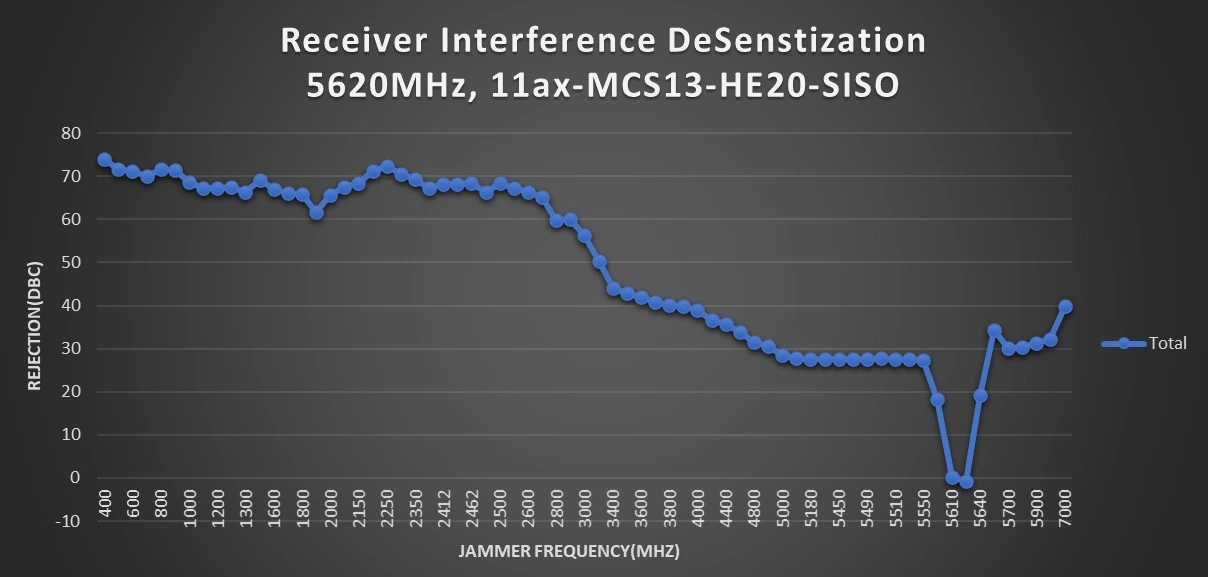
| Interference De-sensitization | 11ax HE20-MCS13 test data available |
| Channel Bandwidths | 5/10/20/40/80/160 MHz |
| Operating System Support | Linux / ath11k |
| RF Antenna Connections | 2 × MMCX |
| Operating Temperature | −40°C to +85°C |
| Published Mechanical Qualification | MIL-STD-810G shock and vibration |
| Security Support | WPA/WPA2/WPA3 and published hardware encryption options |
| Regulatory Compliance | FCC Part 15C – contact enquiry@vizmonet.com for regulatory information |
Measured RF Performance of the axE2-4950
Published specifications provide the starting point for module evaluation, but measured RF performance is also important when assessing a radio for an industrial wireless design. Vizmonet evaluates characteristics such as transmitter modulation quality and receiver behaviour under interference as part of RF performance testing.
Receiver Interference De-sensitization
The following measurement shows receiver interference de-sensitization testing at 5620 MHz using an 802.11ax HE20 configuration. The test provides engineering insight into how receiver rejection changes as interfering signals are introduced across different jammer frequencies.
802.11ax EVM Measurement
Error Vector Magnitude (EVM) is an important indicator of transmitter modulation quality because it measures the difference between the ideal modulation constellation and the measured transmitted signal. The test below shows an 802.11ax RF measurement at a center frequency of 5.775 GHz using a 20 MHz channel configuration.
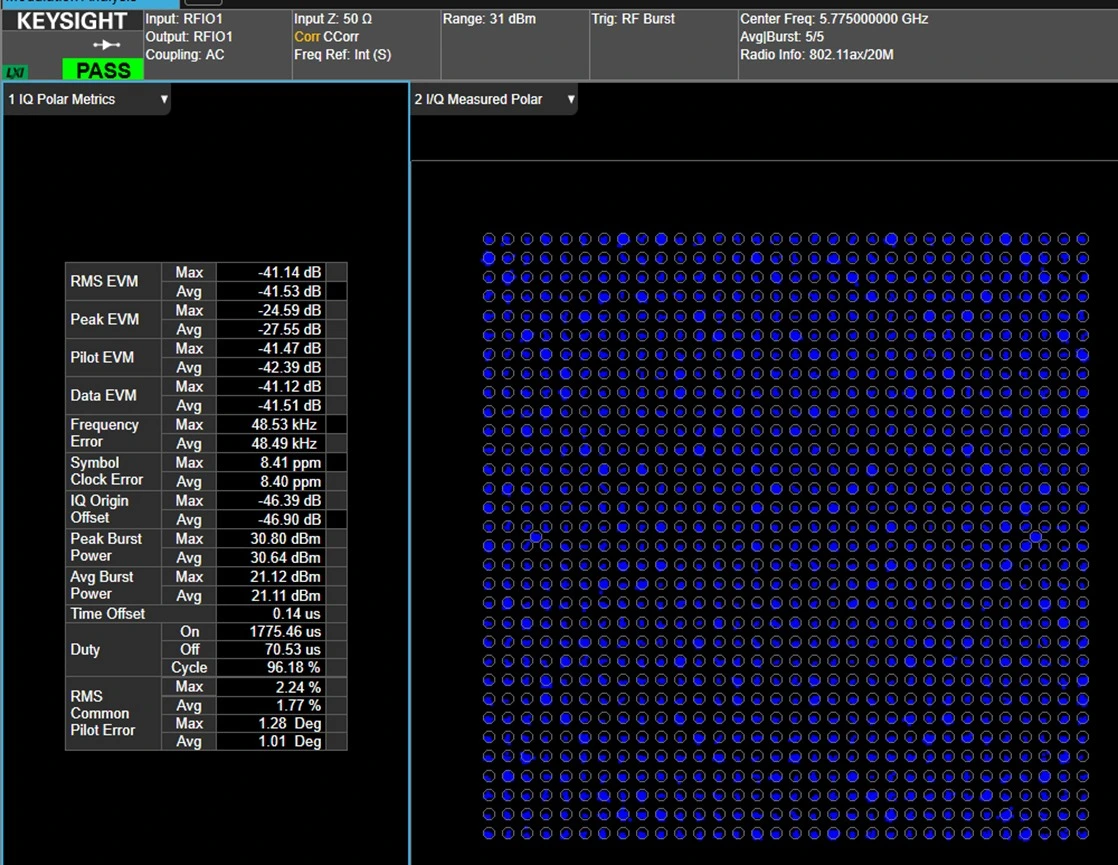
These measurements provide additional engineering context for the RF specifications listed above. They should not be interpreted as a guarantee of a particular field range or system-level performance. Actual performance in a mining vehicle, robotic platform or industrial computer will also depend on antenna integration, channel configuration, interference conditions, installation geometry and the complete RF link.
Those specifications become meaningful only when tied back to the host product.
For example, the Mini PCIe/PCIe Gen 3 interface can align with industrial computers and embedded controllers already designed around that host architecture.
The 2×2 radio configuration requires the antenna system to be considered as part of the complete design rather than as an afterthought.
The 4.9–5.9 GHz operating range provides frequency flexibility, subject to the regulations and channel plan of the target market.
The published −40°C to +85°C operating range is relevant to OEMs designing equipment expected to operate outside normal office temperature conditions.
Support for the open-source ath11k Linux driver can also be important for teams building Linux or OpenWRT-based networking platforms.
None of these specifications, by themselves, guarantee a particular range, latency or field performance.
Those results depend on the completed wireless system.
For that reason, the axE2-4950 is better evaluated as one component in an engineered communication architecture for applications such as:
- Autonomous mining machinery
- Remotely operated equipment
- Mining robotics
- UGV and UGS systems
- Rugged industrial computers
- Embedded networking systems
- Industrial communication gateways
OEM teams evaluating the radio can review the axE2-4950 product page and the axE2-4950 Integration Guide before defining the host design.
Designing the Complete Wireless Link
A common integration mistake is to treat the radio module as the wireless system.
It isn’t.
Consider an autonomous mining vehicle using an onboard radio to communicate with network infrastructure several hundred metres away. Even if the module has sufficient transmit capability, the connection can still underperform because of antenna location, cable loss, obstruction, interference or insufficient link margin.
The practical engineering sequence looks more like this:
Application requirement → frequency plan → radio → antenna → link budget → network topology → field validation
Calculate the Link Budget
A link-budget calculation brings together factors such as:
- Transmitter output
- Antenna gain
- Cable and connector losses
- Path loss
- Receiver sensitivity
- Required link margin
Vizmonet’s RF Link Planner can be used during the design stage to evaluate these variables and compare potential link configurations.
A calculated link budget is still a model. It should be followed by practical testing under representative conditions.
Decide How the Equipment Will Connect
Not every mining system needs the same architecture.
A machine communicating with a nearby fixed node has different requirements from a fleet of moving robotic vehicles that needs communication across a larger operational area.
Depending on the project, the design may involve point-to-point links, access-point infrastructure, multiple fixed nodes or a mesh-oriented architecture.
The network decision should come from mobility, coverage, redundancy, latency and traffic requirements—not because one topology happens to be familiar.
For a broader look at site-level network architecture, see Vizmonet’s guides to mining wireless connectivity and industrial wireless infrastructure for mining and oil & gas.
From axE2-4950 Integration to OEM Product Development
Selecting the radio is often the easy part.
Making it work reliably inside the finished product is where projects become more complicated.
An OEM integrating wireless connectivity may need to coordinate:
- RF architecture
- Antenna selection and placement
- Embedded hardware
- Power and thermal design
- Linux or firmware integration
- Mechanical packaging
- Prototype testing
- Regulatory planning
- Design-for-manufacturing requirements
- Production validation
If each activity is handled independently, problems discovered late in the project can force redesigns elsewhere.
An antenna problem may require a mechanical change. A regulatory requirement may affect the RF configuration. Thermal testing may influence module placement. A driver issue discovered near production can delay an otherwise completed hardware design.
Vizmonet’s OEM Integrated Wireless Product Development approach brings RF engineering, embedded integration, product development, testing, regulatory support and manufacturing considerations into the same development workflow.
For mining equipment and robotics manufacturers, that can be particularly useful when the requirement goes beyond buying a radio card and installing it into an existing computer.
The objective is to develop a wireless subsystem that fits the product and can move toward production with fewer late-stage surprises.
When Should a Mining OEM Consider axE2-4950?
The axE2-4950 deserves consideration when several requirements line up.
Evaluate the axE2-4950 when:
- Your target frequency plan requires capability within its supported 4.9–5.9 GHz range
- The required frequencies are permitted for the intended application and country
- The host platform supports Mini PCIe/PCIe Gen 3
- A 2×2 Wi-Fi 6 radio architecture matches the system requirements
- The equipment operates within the module’s specified environmental limits
- Linux or ath11k compatibility is relevant to the host software environment
- RF and antenna integration are being designed at equipment level
- The project is intended to move beyond proof-of-concept into a repeatable OEM product
It may not be the right radio when the host requires another hardware interface, the application needs another frequency range, a different MIMO architecture is required, or regional spectrum rules do not permit the intended operating configuration.
That decision should happen before the module is designed deeply into the product.
If you are currently defining the communication architecture for a mining vehicle, industrial robot or unmanned ground platform, Vizmonet can review the wireless requirement at system level rather than starting with a predetermined module.
Discuss Your Mining Equipment Wireless Design
Share your target frequency, host platform, antenna constraints, operating environment and communication requirements with the Vizmonet engineering team.
You can also view the axE2-4950 or review the axE2-4950 Integration Guide before starting your evaluation.
Frequently Asked Questions
What is a Mini PCIe Wi-Fi module used for in mining equipment?
A Mini PCIe Wi-Fi module can add embedded wireless connectivity to compatible industrial computers, controllers, gateways and robotic systems. In mining equipment, that connection may carry command data, telemetry, machine status, sensor information, diagnostics or video depending on the system architecture.
Why would an OEM evaluate 4.9–5.9 GHz wireless for mining connectivity?
An OEM may evaluate frequencies within the 4.9–5.9 GHz operating range when they are appropriate for the planned communication architecture and permitted in the target jurisdiction. Frequency availability and licensing requirements vary by country and application, so regulatory verification should take place before the design is finalized.
Can axE2-4950 be used in autonomous mining vehicles or robotic platforms?
The axE2-4950 can be evaluated for autonomous mining equipment, UGV/UGS systems and robotic platforms when its Mini PCIe interface, 4.9–5.9 GHz operating range, 2×2 Wi-Fi 6 architecture, software support and environmental specifications match the requirements of the host system. Final suitability depends on the complete equipment and RF design.
Does 30 dBm transmit power guarantee long-range communication?
No. Transmit power is only one part of wireless link performance. Antenna gain and placement, cable loss, receiver sensitivity, propagation loss, interference, channel bandwidth, obstructions and link margin all influence the usable communication range.
How does antenna selection affect a mining equipment wireless link?
The antenna influences signal direction, gain, polarization and overall link efficiency. Its mounting position also matters, particularly on large metal vehicles and mobile robotic systems. Antenna selection should therefore be included in RF planning rather than handled after the radio has already been integrated.
Does the axE2-4950 support Linux?
Yes. Vizmonet’s published specifications state that the axE2-4950 supports Linux using the open-source ath11k wireless driver. OEMs should still validate compatibility against the specific Linux distribution, kernel, host platform and software configuration planned for the finished product.
Can Vizmonet help integrate axE2-4950 into an OEM mining product?
Yes. Vizmonet provides OEM wireless product-development capabilities covering areas such as RF engineering, wireless module integration, embedded development, antenna considerations, validation, regulatory support and manufacturing preparation. The exact scope can be defined around the OEM’s host platform and product requirements.