
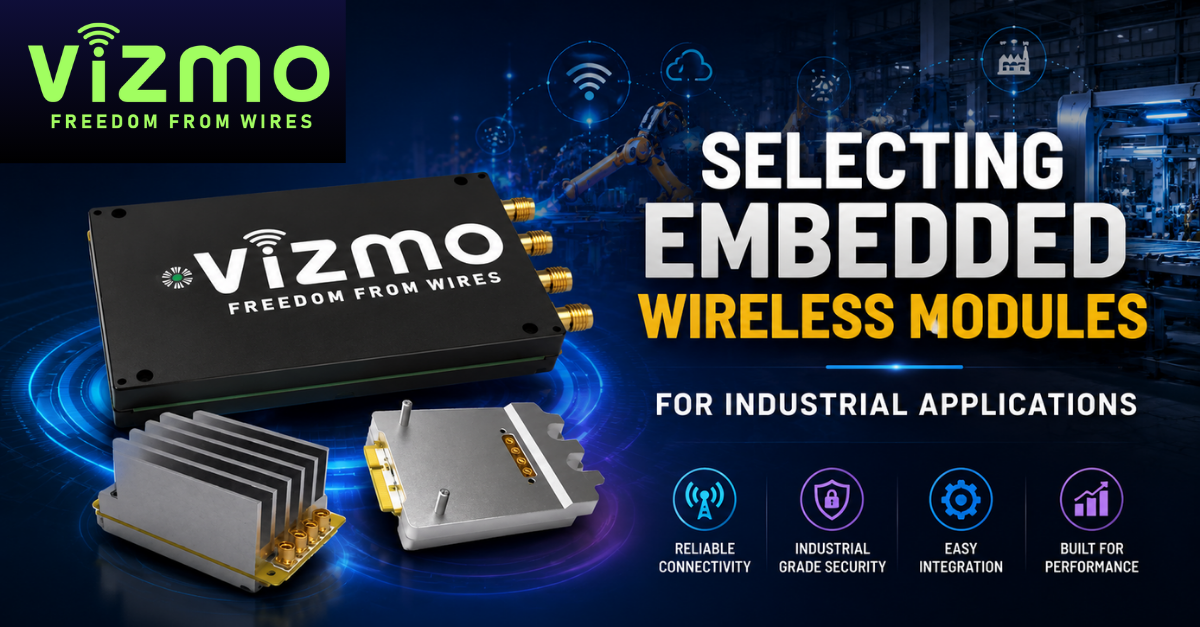
How to Select Embedded Wireless Modules for Industrial Applications
Selecting the right embedded wireless modules is one of the most important decisions in industrial product development. The right embedded wireless modules help ensure reliable connectivity, regulatory compliance, and long-term scalability for Industrial IoT deployments.
Whether you are designing industrial IoT devices, smart manufacturing equipment, remote monitoring systems, or connected infrastructure, wireless connectivity directly impacts product performance, reliability, security, and time-to-market.
Industrial environments are often challenging. Metal structures, RF interference, extreme temperatures, and long deployment lifecycles require wireless solutions that are more robust than consumer-grade alternatives.
Since 2011, Vizmonet has helped Industrial OEMs accelerate wireless product development through RF engineering expertise, embedded wireless design, regulatory support, and turnkey manufacturing services.
This guide explains the key factors to evaluate when selecting embedded wireless modules for industrial applications.
Why Embedded Wireless Modules Are Critical for Industrial Applications
Industrial organizations are increasingly deploying connected devices to improve efficiency, reduce downtime, and collect real-time operational data.
Embedded wireless modules help manufacturers:
- Accelerate product development
- Reduce RF engineering complexity
- Simplify certification processes
- Improve device connectivity
- Enable Industrial IoT deployments
- Support long-term product scalability
Instead of designing wireless hardware from scratch, OEMs can integrate pre-certified wireless modules into their products and significantly reduce development risk while speeding up time-to-market. Learn more about Vizmonet’s Embedded Wireless Systems.
1. Choose the Right Wireless Technology
Not every application requires the same wireless technology.
| Technology | Best For |
|---|---|
| Wi-Fi | High-speed industrial networking |
| Wi-Fi HaLow | Long-range industrial IoT |
| Bluetooth LE | Short-range monitoring |
| Zigbee | Mesh networking |
| LoRaWAN | Ultra-long-range sensors |
| Cellular LTE/5G | Wide-area connectivity |
For example, a machine vision system may require high-bandwidth Wi-Fi connectivity, while a remote monitoring sensor may benefit from Wi-Fi HaLow technology or LoRaWAN.
For long-range deployments, OEMs can also evaluate Vizmonet’s AHSP1 Wi-Fi HaLow Module.
2. Evaluate Industrial Operating Conditions
Industrial wireless communication must remain reliable in harsh environments.
- Electromagnetic interference (EMI)
- Metal obstructions
- Outdoor deployment
- High humidity
- Dust exposure
- Extreme temperatures
- Mechanical vibration
Industrial-grade embedded wireless modules are specifically designed to perform under these demanding conditions. Vizmonet’s Industrial RF Modules are engineered for mission-critical industrial applications.
3. Understand Range Requirements
Range is one of the most important selection criteria.
- How far must devices communicate?
- Are devices deployed indoors or outdoors?
- Are there physical obstacles?
- Is roaming required?
Applications such as warehouses, utilities, mining operations, and smart infrastructure often require long-range connectivity solutions that maintain performance across large coverage areas.
Read our guide on Wi-Fi HaLow Frequency Range and Coverage.
5. Prioritize Security
Cybersecurity is now a critical requirement for Industrial IoT deployments.
- WPA3 security
- Secure boot
- Hardware encryption
- Device authentication
- Secure firmware updates
- Protected key storage
Strong security protects operational technology (OT) networks and helps prevent unauthorized access.
For cybersecurity best practices, refer to the NIST Cybersecurity Framework.
6. Regulatory Compliance and Certification Support
Keeping pace with evolving regulatory requirements remains a significant challenge for OEMs.
By selecting the right embedded wireless modules and partnering with an experienced ODM, OEMs can streamline certification processes and accelerate time-to-market.
- FCC
- CE
- IC
- TELEC
- KC
- RCM
Learn more about Vizmonet’s Global Regulatory Compliance Services.
Read our article on FCC Certification for Wireless Modules.
7. Consider Integration Support
- SDK availability
- API support
- Documentation quality
- Development kits
- Technical support
- Product lifecycle availability
- Customization capabilities
Strong engineering support can dramatically reduce development time.
Vizmonet works closely with OEMs to customize wireless solutions that align with specific application requirements.
Explore our OEM Integrated Wireless Product Development Services.
Need RF expertise? Visit our RF Engineering Services.
Future-Proofing Industrial Wireless Connectivity
- Firmware update capabilities
- Long-term component availability
- Network scalability
- Security updates
- Future connectivity requirements
A scalable wireless platform helps protect investments and supports evolving business needs.
Learn how SWaP-C optimization impacts future-ready designs in our guide on SWaP-C Optimization in Embedded Wireless Design.
Conclusion
Selecting the right embedded wireless modules requires careful evaluation of connectivity requirements, operating conditions, security needs, certifications, integration support, and long-term scalability.
Industrial OEMs that choose reliable, industrial-grade wireless solutions can reduce development risk, accelerate product launches, and deliver dependable connectivity in even the most challenging environments.
At Vizmonet, we help OEMs accelerate wireless product development through high-performance embedded wireless modules, RF engineering expertise, and cradle-to-grave product lifecycle support.
Need help selecting the right embedded wireless module for your application? Contact Vizmonet’s wireless experts today.