
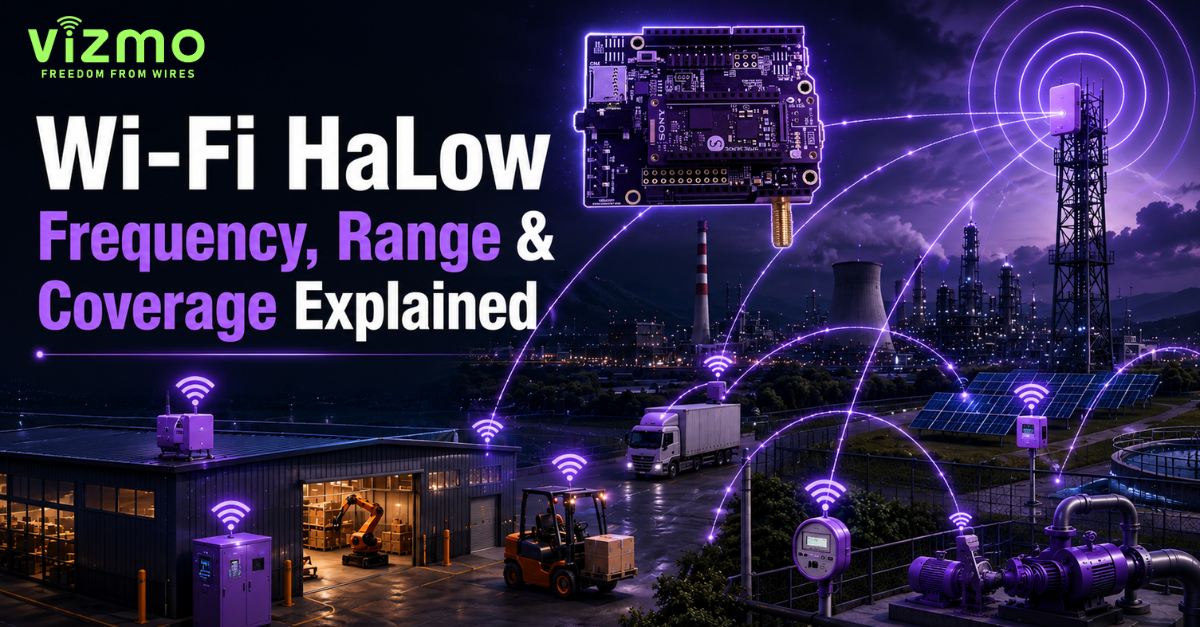
Wi-Fi HaLow Frequency, Range, and Coverage Explained: A Complete Industrial IoT Guide
Industrial IoT deployments are rapidly expanding across manufacturing, mining, utilities, transportation, agriculture, and critical infrastructure. As organizations connect more sensors, machines, vehicles, and control systems, traditional wireless technologies often struggle to deliver the combination of range, power efficiency, and scalability required for modern industrial environments.
This is where Wi-Fi HaLow emerges as a compelling solution.
Built on the IEEE 802.11ah standard, Wi-Fi HaLow is designed specifically for long-range, low-power wireless communication. Unlike conventional Wi-Fi technologies that operate in the crowded 2.4 GHz, 5 GHz, and 6 GHz bands, Wi-Fi HaLow operates in Sub-GHz frequencies, enabling significantly greater coverage and improved signal penetration.
For Industrial IoT applications where connectivity reliability directly impacts operational efficiency and safety, understanding Wi-Fi HaLow frequency characteristics, range capabilities, and coverage advantages is essential. Organizations exploring industrial wireless connectivity can also review Vizmonet’s guide on why Sub-1 GHz Wi-Fi HaLow is important.
What Is Wi-Fi HaLow?
Wi-Fi HaLow is a wireless communication technology based on the IEEE 802.11ah standard. It was developed to address the connectivity challenges associated with IoT devices and industrial wireless networks.
Traditional Wi-Fi technologies were primarily designed for high-speed data communication over relatively short distances. Industrial IoT environments, however, often require:
- Long-distance communication
- Low power consumption
- Large-scale device connectivity
- Reliable operation in challenging RF environments
- Secure IP-based networking
Wi-Fi HaLow was specifically engineered to meet these requirements. Vizmonet’s AHSP1 Wi-Fi HaLow Module demonstrates how IEEE 802.11ah technology can be implemented in real-world Industrial IoT deployments.
Key Characteristics of Wi-Fi HaLow
- Operates in Sub-GHz frequency bands
- Supports long-range communication
- Lower power consumption
- Native IP connectivity
- Strong security architecture
- High device scalability
- Improved obstacle penetration
These characteristics make Wi-Fi HaLow particularly attractive for Industrial IoT deployments where traditional wireless communication systems may face limitations.
Understanding Wi-Fi HaLow Frequency Bands
One of the most significant advantages of Wi-Fi HaLow is its use of Sub-GHz spectrum.
Depending on regional regulations, Wi-Fi HaLow typically operates in frequency bands around:
| Region | Frequency Band |
|---|---|
| United States | 902–928 MHz |
| Europe | 863–868 MHz |
| Japan | 916–928 MHz |
| Other Regions | Country-specific allocations |
These Sub-GHz frequency bands enable longer wireless communication distances than conventional Wi-Fi technologies. To better understand the benefits of operating below 1 GHz, explore Vizmonet’s article on Sub-GHz Wi-Fi HaLow technology. Additional information on certification and interoperability can be found through the Wi-Fi Alliance’s Wi-Fi CERTIFIED HaLow program.
Why Sub-GHz Frequencies Matter
Wireless signals at lower frequencies generally travel farther and experience less attenuation compared to higher-frequency signals.
This provides several advantages:
Better Wall Penetration
Industrial facilities often contain:
- Metal structures
- Machinery
- Concrete walls
- Storage racks
- Underground infrastructure
Sub-GHz signals can penetrate these obstacles more effectively than traditional Wi-Fi. This capability is one of the primary reasons why Sub-1 GHz Wi-Fi HaLow technology is gaining attention across Industrial IoT deployments.
Extended Coverage
A single Wi-Fi HaLow access point can cover substantially larger areas than conventional Wi-Fi deployments, reducing infrastructure requirements and simplifying network design.
Improved Reliability
Reduced signal attenuation helps maintain connectivity in RF-challenging industrial environments. Organizations planning large-scale wireless deployments can leverage Vizmonet’s RF Link Planner to evaluate expected coverage performance.
Wi-Fi HaLow vs Traditional Wi-Fi Frequencies
| Technology | Frequency |
|---|---|
| Wi-Fi HaLow | Sub-GHz |
| Wi-Fi 4 | 2.4 GHz / 5 GHz |
| Wi-Fi 5 | 5 GHz |
| Wi-Fi 6 | 2.4 GHz / 5 GHz |
| Wi-Fi 6E | 6 GHz |
While Wi-Fi 6 and Wi-Fi 6E focus on higher throughput and lower latency, Wi-Fi HaLow focuses on maximizing range and coverage for IoT applications.
This distinction makes Wi-Fi HaLow particularly suitable for Industrial IoT connectivity. Readers interested in broader wireless technology comparisons can also explore Wi-Fi HaLow vs Wi-Fi vs RF Modules.
Industrial OEMs evaluating next-generation wireless hardware may also consider Vizmonet’s Wi-Fi 6 MiniPCIe modules and Wi-Fi 6E wireless modules for applications where throughput is prioritized over long-range coverage.
How Far Can Wi-Fi HaLow Reach?
One of the most common questions surrounding Wi-Fi HaLow is its communication range.
The answer depends on multiple factors, including:
- Antenna design
- Environmental conditions
- Transmit power
- Receiver sensitivity
- Physical obstacles
- Regulatory constraints
Accurately estimating wireless communication range requires proper RF planning and link budget analysis. Vizmonet provides an RF Link Budget Calculation Guide that explains how signal strength, antenna gain, and environmental factors influence wireless coverage.
Typical Wi-Fi HaLow Range
| Environment | Typical Range |
|---|---|
| Indoor Industrial Facility | Hundreds of meters |
| Warehouse | Up to 1 kilometer |
| Campus Environment | Several kilometers |
| Open Outdoor Area | Multiple kilometers |
Compared to traditional Wi-Fi, Wi-Fi HaLow can deliver significantly greater communication distances while maintaining reliable connectivity. Organizations planning long-range Industrial IoT deployments can use Vizmonet’s RF Link Planner to model coverage requirements and optimize wireless network design.
Why Wi-Fi HaLow Achieves Longer Range
Several technical factors contribute to its extended range:
Lower Frequency Propagation
Sub-GHz signals naturally travel farther than higher-frequency signals. This is a key advantage discussed in Vizmonet’s guide on why Sub-1 GHz Wi-Fi HaLow is important.
Enhanced Link Budget
Improved receiver sensitivity and optimized modulation schemes contribute to stronger communication links. Understanding link budget calculations is essential when designing Industrial IoT networks for maximum coverage.
Reduced Path Loss
Lower-frequency signals experience less free-space path loss, helping maintain stronger connections over longer distances.
Industrial-Grade RF Design
Proper antenna selection and RF engineering can further maximize coverage performance. Wireless system optimization, antenna placement, and RF validation are critical for achieving reliable communication in industrial environments.
For engineers designing outdoor wireless systems, Vizmonet’s RF Link Budget Calculation Guide provides additional insights into range prediction and network performance analysis.
Wi-Fi HaLow Coverage Compared to Other Wireless Technologies
Selecting the right wireless technology requires understanding how Wi-Fi HaLow compares to alternative solutions. While traditional Wi-Fi, LoRaWAN, Zigbee, and RF modules each serve specific use cases, Wi-Fi HaLow uniquely combines long-range coverage, IP-based networking, and Industrial IoT scalability. For a broader comparison of wireless technologies, read Wi-Fi HaLow vs Wi-Fi vs RF Modules.
Wi-Fi HaLow vs Traditional Wi-Fi
| Feature | Wi-Fi HaLow | Traditional Wi-Fi |
|---|---|---|
| Range | Excellent | Moderate |
| Coverage | Excellent | Limited |
| Power Consumption | Lower | Higher |
| IoT Scalability | High | Moderate |
| Penetration | Excellent | Moderate |
| Throughput | Moderate | High |
Traditional Wi-Fi technologies such as Wi-Fi 4, Wi-Fi 6, and Wi-Fi 6E are optimized for high-speed connectivity, while Wi-Fi HaLow is designed to maximize coverage, power efficiency, and Industrial IoT scalability.
Wi-Fi HaLow vs LoRaWAN
| Feature | Wi-Fi HaLow | LoRaWAN |
|---|---|---|
| IP Connectivity | Native | Gateway Required |
| Data Rate | Higher | Lower |
| Device Density | High | High |
| Range | Long | Very Long |
| Latency | Lower | Higher |
Wi-Fi HaLow provides native IP connectivity and higher throughput, making it well suited for Industrial IoT applications that require real-time monitoring, firmware updates, and direct integration with enterprise networks. For a more detailed technology comparison, see Wi-Fi HaLow vs Wi-Fi vs RF Modules.
Wi-Fi HaLow vs Zigbee
| Feature | Wi-Fi HaLow | Zigbee |
|---|---|---|
| Coverage | Greater | Limited |
| Network Complexity | Lower | Higher |
| IP Compatibility | Native | Limited |
| Industrial Deployment | Strong | Moderate |
Compared to Zigbee, Wi-Fi HaLow offers broader coverage and simplified IP networking, reducing the complexity of large-scale Industrial IoT deployments.
Why Wi-Fi HaLow Is Ideal for Industrial IoT Connectivity
Industrial environments require connectivity solutions capable of supporting thousands of connected assets while maintaining reliability and security.
Wi-Fi HaLow addresses several Industrial IoT challenges simultaneously.
Smart Manufacturing
Factories increasingly rely on:
- Machine monitoring
- Predictive maintenance
- Wireless sensors
- Autonomous equipment
- Production analytics
Wi-Fi HaLow enables reliable connectivity across large manufacturing facilities. Learn how wireless connectivity supports modern Industry 4.0 applications.
Mining Operations
Mining sites often face extreme connectivity challenges due to:
- Large geographic areas
- Harsh environmental conditions
- Mobile assets
- Remote operations
Long-range wireless communication significantly reduces infrastructure requirements. Explore Vizmonet’s Mining Applications for real-world deployment examples.
Oil & Gas Facilities
Critical monitoring systems require dependable communication links for:
- Pipeline monitoring
- Asset tracking
- Environmental monitoring
- Safety systems
Wi-Fi HaLow can help extend connectivity into difficult-to-reach locations. Discover how wireless technologies support Oil & Gas Applications.
Utilities and Smart Infrastructure
Applications include:
- Smart metering
- Grid monitoring
- Water management
- Remote asset management
Extended coverage reduces deployment costs while improving operational visibility across Industrial IoT networks.
Transportation and Logistics
Wi-Fi HaLow supports:
- Fleet monitoring
- Warehouse automation
- Container tracking
- Yard management systems
Its long-range capabilities make it particularly useful in large logistics facilities, autonomous systems, and connected transportation infrastructure. Similar wireless technologies are also used in Unmanned Ground Systems and Unmanned Aerial Systems.
Key Factors Affecting Wi-Fi HaLow Performance
While Wi-Fi HaLow offers significant advantages, network performance depends on proper engineering and deployment planning.
Antenna Selection
Antenna design directly impacts:
- Coverage area
- Signal strength
- Reliability
- Network efficiency
Proper antenna selection is essential for maximizing Wi-Fi HaLow coverage and long-range performance. Organizations developing custom wireless solutions often rely on RF engineering services to optimize antenna placement, link performance, and network reliability.
RF Environment Analysis
Industrial environments often contain sources of interference that require careful evaluation. Performing RF analysis before deployment helps identify potential coverage gaps and optimize network performance. Vizmonet’s RF Link Planner can assist engineers in evaluating wireless communication scenarios.
Device Placement
Strategic placement of gateways, access points, and endpoints improves overall network performance. Proper positioning minimizes interference and maximizes signal propagation throughout industrial facilities.
Network Architecture
A properly designed wireless architecture ensures scalability and long-term reliability. Organizations building Industrial IoT infrastructure should consider future device growth, application requirements, and network expansion plans.
Regulatory Compliance
Regional frequency regulations must be considered during product design and deployment. Compliance with global wireless standards helps ensure successful product commercialization and international market access. Learn more about global regulatory compliance and homologation requirements for wireless products.
Designing Successful Industrial Wi-Fi HaLow Networks
Successful deployments typically follow several best practices.
Conduct RF Site Surveys
Understanding environmental conditions helps optimize network planning. RF surveys identify coverage challenges and support effective wireless infrastructure design.
Select Appropriate Hardware
Industrial-grade hardware improves reliability in harsh operating conditions. Solutions such as the AHSP1 Wi-Fi HaLow Module can provide long-range connectivity for Industrial IoT deployments.
Design for Scalability
Future device growth should be considered during initial deployment planning. Scalable architectures reduce future infrastructure costs and support long-term operational requirements.
Prioritize Security
Industrial IoT deployments require robust cybersecurity measures. Secure communication, authentication mechanisms, and network monitoring should be incorporated from the beginning.
Validate Coverage
Testing and optimization should be performed before full-scale deployment. Engineers can leverage RF modeling techniques and tools such as Vizmonet’s RF Link Budget Calculation Guide to improve network performance predictions.
How Vizmonet Supports Advanced Wireless Connectivity Solutions
As Industrial IoT applications continue to evolve, successful deployments require expertise beyond selecting a wireless technology.
Vizmonet specializes in helping OEMs and industrial technology companies develop high-performance wireless products and connectivity solutions.
Core capabilities include:
- RF Engineering Services
- Embedded Systems Development
- Custom Wireless System Development
- Original Design Manufacturing (ODM)
- Turnkey Manufacturing Services
- PCB Assembly Manufacturing
- Box-Build Manufacturing
- Regulatory Approvals and Product Certification
With experience supporting mission-critical wireless applications, Vizmonet helps organizations accelerate product development while addressing performance, compliance, and manufacturing requirements. Companies evaluating wireless hardware partners can also review the Wireless Module Supplier Checklist.
Conclusion
Wi-Fi HaLow represents an important advancement in industrial wireless communication technology. By leveraging Sub-GHz frequency bands, IEEE 802.11ah enables long-range, reliable, and power-efficient connectivity that addresses many of the challenges faced by Industrial IoT deployments.
Its combination of extended range, strong coverage, native IP networking, and scalability makes it an attractive solution for manufacturing, mining, utilities, transportation, smart infrastructure, autonomous systems, and other mission-critical applications.
Organizations exploring Industrial IoT connectivity can review Vizmonet’s Wi-Fi HaLow solutions and broader wireless product portfolio to evaluate deployment options.
As Industrial IoT ecosystems continue to expand, Wi-Fi HaLow is expected to play an increasingly important role in enabling the next generation of connected industrial operations.
FAQ: Wi-Fi HaLow
1. What is Wi-Fi HaLow?
Wi-Fi HaLow is a wireless communication technology based on the IEEE 802.11ah standard that operates in Sub-GHz frequency bands to provide long-range, low-power connectivity.
2. What frequency does Wi-Fi HaLow use?
Wi-Fi HaLow operates in regional Sub-GHz frequency bands, typically around 900 MHz depending on local regulations
3. How far can Wi-Fi HaLow transmit data?
Wi-Fi HaLow can support communication ranging from hundreds of meters to several kilometers depending on deployment conditions.
4. Is Wi-Fi HaLow suitable for Industrial IoT?
Yes. Wi-Fi HaLow is specifically designed for IoT applications requiring long-range connectivity, low power consumption, and large-scale device support.
5. What is the difference between Wi-Fi HaLow and LoRaWAN?
Wi-Fi HaLow offers native IP connectivity and higher throughput, while LoRaWAN focuses on ultra-low-power communication with lower data rates