
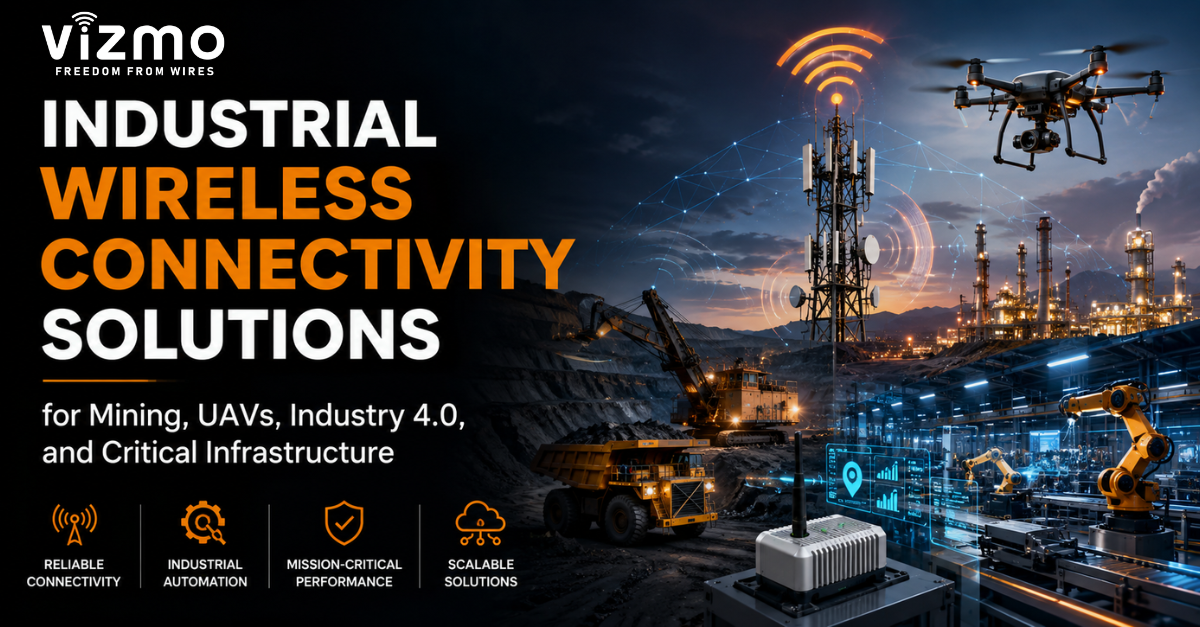
Industrial Wireless Connectivity Solutions for Mining, UAVs, Industry 4.0, and Critical Infrastructure
Industrial industries are rapidly transitioning toward connected infrastructure, automation, real-time monitoring, and autonomous operations. From mining sites and oil & gas facilities to smart manufacturing environments and unmanned systems, reliable wireless communication has become essential for maintaining operational efficiency, safety, and scalability.
Modern industrial environments require communication systems capable of delivering reliable connectivity across remote locations, harsh operating conditions, and mission-critical deployments where network performance directly impacts productivity and operational continuity.
Industrial wireless communication systems now support some of the world’s most demanding applications, including mining connectivity,UAV communication systems, Industry 4.0 automation,
public safety networks, heavy construction operations, and remote industrial infrastructure.
As organizations continue adopting industrial IoT and connected operational technologies, scalable wireless communication infrastructure is becoming the backbone of modern industrial operations.
According to the IEEE, industrial wireless technologies are becoming increasingly important for connected infrastructure and operational automation.
Why Industrial Wireless Connectivity Matters
Traditional wired communication infrastructure often struggles in industrial environments where mobility, flexibility, and rapid deployment are critical. Large operational areas, harsh terrain, moving equipment, and constantly changing site layouts require communication systems that can adapt without extensive infrastructure limitations.
Industrial wireless connectivity solutions help organizations:
- Improve operational visibility
- Support industrial automation
- Enable real-time monitoring
- Reduce infrastructure complexity
- Improve worker safety
- Support autonomous systems
- Scale industrial IoT deployments
- Improve operational efficiency
Wireless communication technologies are now widely used to connect industrial sensors, autonomous vehicles, monitoring platforms, industrial equipment, and remote operational systems across multiple industries.
Mining Connectivity Solutions for Harsh Industrial Environments
Mining operations are among the most challenging environments for communication infrastructure. Underground tunnels, remote locations, dust, vibration, and moving equipment create conditions where traditional wired systems become difficult and expensive to maintain.
Industrial wireless communication systems support modern mining operations through:
- Autonomous mining vehicle connectivity
- Real-time environmental monitoring
- Remote equipment diagnostics
- Worker safety communication systems
- Asset tracking and monitoring
- Industrial video surveillance
- Predictive maintenance systems
Industrial mesh networking is particularly effective in mining operations because it enables resilient communication between connected devices and operational systems across large mining environments.
Reliable mining connectivity solutions help operators improve safety, reduce downtime, and maintain operational visibility across critical infrastructure.
Oil & Gas Wireless Communication Infrastructure
Oil & gas operations require reliable communication systems capable of operating continuously across hazardous and remote industrial environments.
Industrial wireless connectivity supports applications including:
- Pipeline monitoring systems
- SCADA communication networks
- Remote asset management
- Leak detection infrastructure
- Environmental monitoring systems
- Worker safety platforms
- Remote inspection operations
Wireless infrastructure allows operators to deploy scalable communication systems across large operational areas while reducing dependence on complex wired installations.
As energy operations become increasingly automated, industrial wireless communication networks play a critical role in supporting real-time operational monitoring and connected infrastructure.
Smart Agriculture and Remote Monitoring Systems
Agriculture is increasingly adopting industrial IoT and connected monitoring systems to improve productivity, sustainability, and operational efficiency.
Industrial wireless communication systems support smart agriculture applications such as:
- Precision agriculture systems
- Smart irrigation infrastructure
- Livestock tracking
- Remote environmental monitoring
- Agricultural equipment monitoring
- Automated farming operations
- Sensor-based crop management
Reliable long-range wireless communication allows agricultural operators to monitor large farming environments while improving resource management and operational decision-making.
Connected agriculture infrastructure also helps optimize water usage, equipment utilization, and environmental monitoring across remote agricultural operations.
Heavy Construction Sites Require Flexible Wireless Networks
Construction environments are highly dynamic operational spaces where communication infrastructure must adapt quickly to changing site conditions.
Industrial wireless communication systems support:
- Real-time construction site communication
- Heavy equipment monitoring
- Worker safety systems
- Temporary wireless infrastructure
- Site surveillance systems
- Autonomous construction equipment
- Remote project monitoring
Unlike traditional fixed infrastructure, wireless communication systems provide the flexibility required to support constantly evolving construction environments without extensive network redesign.
Reliable wireless connectivity helps improve coordination, safety, and operational efficiency across large-scale construction operations.
UAV Communication Systems and Autonomous Connectivity
Unmanned aerial systems (UAVs) rely heavily on stable wireless communication for telemetry, navigation, coordination, and real-time data transmission.
Modern UAV communication systems support applications across industries including:
- Mining inspections
- Infrastructure monitoring
- Agriculture operations
- Public safety surveillance
- Environmental monitoring
- Industrial asset inspection
- Disaster response operations
Reliable long-range wireless communication enables autonomous aerial systems to operate effectively across remote and challenging operational environments.
As industrial drone deployments continue expanding, scalable UAV connectivity solutions are becoming increasingly important for supporting autonomous operations and real-time situational awareness.
Learn more about global UAV regulations and drone communication standards from the Federal Aviation Administration (FAA).
Unmanned Ground Systems and Industrial Automation
Unmanned ground systems (UGS) are increasingly used across industrial automation, defense, logistics, surveillance, and remote operational environments.
These systems require reliable communication infrastructure to support:
- Autonomous navigation
- Vehicle-to-vehicle communication
- Sensor integration
- Real-time telemetry
- Remote control systems
- Operational monitoring
Industrial wireless communication systems help ensure continuous connectivity in environments where traditional infrastructure may not be practical or available.
Reliable wireless infrastructure is especially important in mission-critical deployments where communication interruptions can directly impact operational performance and safety.
Industry 4.0 and Industrial IoT Connectivity
Industry 4.0 is transforming manufacturing environments through industrial IoT, robotics, automation, predictive maintenance, and connected production systems.
Industrial wireless connectivity supports:
- Smart manufacturing infrastructure
- Industrial IoT deployments
- Robotics communication systems
- Automated production monitoring
- Predictive maintenance platforms
- Autonomous material handling
- Real-time operational analytics
Industrial wireless networks help manufacturers improve operational flexibility while supporting scalable and connected production environments.
As manufacturing facilities continue adopting automation technologies, industrial wireless infrastructure is becoming central to supporting efficient and intelligent operations.
Research from McKinsey & Company highlights the growing importance of industrial IoT and smart manufacturing technologies across modern industries.
Public Safety Wireless Communication Systems
Public safety organizations require resilient communication infrastructure capable of remaining operational during emergencies and infrastructure disruptions.
Industrial wireless communication systems support:
- Emergency response coordination
- Disaster recovery communication
- Tactical communication systems
- Temporary wireless deployments
- Mobile surveillance platforms
- Incident monitoring operations
Rapid deployment capabilities are especially important in emergency environments where reliable communication infrastructure must be established quickly and securely.
Industrial wireless networks help first responders maintain operational coordination and communication reliability during mission-critical situations.
Explore more industrial wireless and RF connectivity solutions on the Vizmonet official website.
Frequently Asked Questions
What are industrial wireless communication systems?
Industrial wireless communication systems are wireless networking solutions designed for industrial and mission-critical environments. These systems support applications such as industrial IoT, mining operations, UAV communication, Industry 4.0 automation, public safety networks, and remote infrastructure monitoring.
Why are industrial wireless communication systems important?
Industrial wireless communication systems help organizations improve operational efficiency, real-time monitoring, automation, worker safety, and connectivity across large or remote industrial environments where wired infrastructure may not be practical.
How are wireless communication systems used in mining operations?
Mining operations use wireless communication systems for autonomous vehicle connectivity, worker safety communication, environmental monitoring, industrial surveillance, predictive maintenance, and real-time operational visibility across harsh mining environments.
What industries use industrial wireless communication systems?
Industries including mining, oil & gas, agriculture, heavy construction, manufacturing, public safety, defense, logistics, and industrial IoT sectors use industrial wireless communication systems to support connected operations and automation.
How do UAV communication systems support industrial operations?
UAV communication systems enable reliable drone connectivity for telemetry, remote monitoring, infrastructure inspection, surveillance, disaster response, environmental monitoring, and industrial asset management.
What is the role of industrial wireless connectivity in Industry 4.0?
Industrial wireless connectivity supports Industry 4.0 technologies such as industrial IoT, robotics, predictive maintenance, automated manufacturing, real-time analytics, and connected production systems.
What are the benefits of long-range wireless communication systems?
Long-range wireless communication systems provide reliable connectivity across large industrial areas, reduce infrastructure complexity, support remote monitoring, improve scalability, and enable communication in challenging operational environments.
How does Vizmonet support industrial wireless connectivity solutions?
Vizmonet provides RF engineering, embedded wireless systems, turnkey manufacturing, PCB assembly, box-build manufacturing, and regulatory support for industrial wireless communication systems across mining, UAV, Industry 4.0, public safety, and industrial IoT applications.