
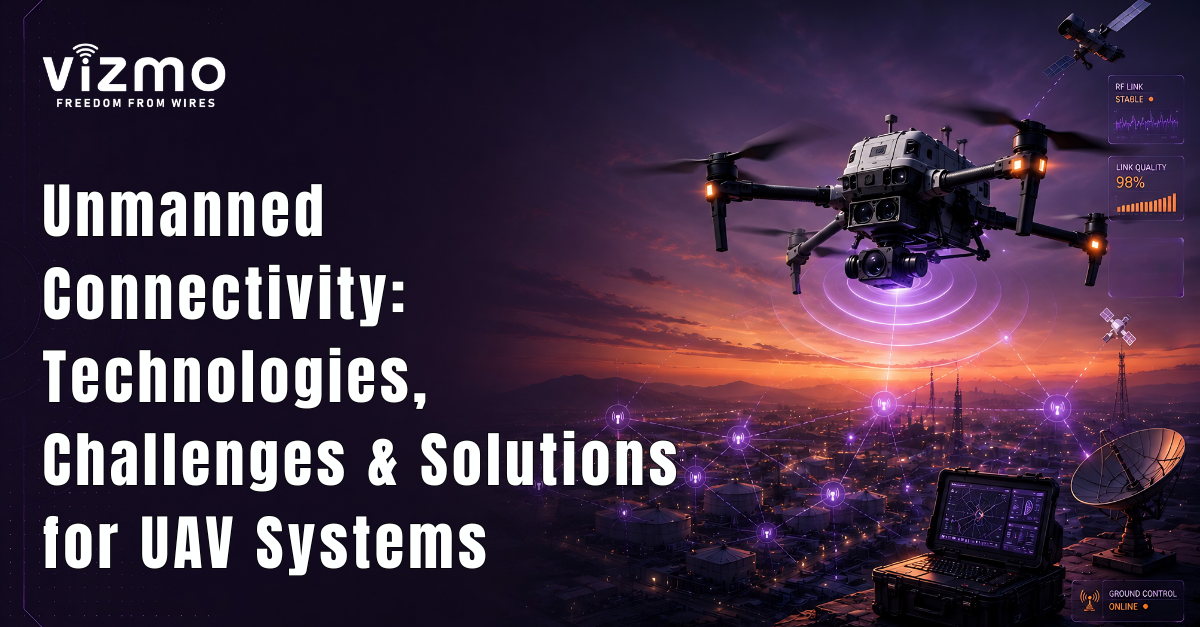
Unmanned Connectivity: Technologies, Challenges & Solutions for UAV Systems
Unmanned connectivity is a foundational component of modern Unmanned Aerial Systems (UAS), enabling real-time communication between aerial platforms, ground control systems, and network infrastructure.
As UAV deployments expand across industrial, defense, and emergency response sectors, the need for reliable, low-latency, and interference-resilient communication systems has become critical.
From high-definition video transmission to precision command-and-control (C2) links, unmanned connectivity directly influences mission success, operational safety, and system scalability.
What is Unmanned Connectivity?
Unmanned connectivity refers to the wireless communication framework that allows UAVs to exchange data, receive control commands, and operate autonomously or semi-autonomously.
A typical UAV communication system includes:
- RF transceivers and embedded wireless modules
- Ground control stations (GCS)
- Telemetry and data links
- Network protocols for routing and redundancy
These systems support:
- Real-time video streaming
- Sensor and telemetry data transmission
- Remote flight control
- Autonomous mission execution
In mission-critical environments, connectivity is not optional—it is mission-defining infrastructure.
Key Technologies Enabling UAV Connectivity
1. RF-Based Communication Systems
Radio frequency (RF) communication remains the backbone of UAV connectivity, offering low latency and deterministic performance for control and telemetry.
2. Mesh Networking for UAVs
Mesh networks enable drones to communicate with each other, creating a self-healing, multi-node communication system.
Benefits:
- Extended range via multi-hop communication
- Improved redundancy
- High reliability in dynamic environments
3. Industrial Wi-Fi & High-Throughput Wireless
Used for data-intensive applications such as HD video streaming and LiDAR payloads.
4. Cellular Connectivity (LTE / 5G)
Provides extended coverage using existing infrastructure, especially in urban environments.
5. Satellite Communication (SATCOM)
Essential for beyond-line-of-sight (BLOS) operations in remote or offshore areas.
Challenges in Drone Communication Systems
Despite technological advancements, UAV communication systems face several operational challenges:
RF Interference
Dense spectrum environments can degrade signal quality and increase packet loss.
Latency Sensitivity
Even minor delays can impact control accuracy and real-time decision-making.
Limited Range
Signal attenuation over distance restricts operational coverage.
Network Instability
Dynamic UAV movement introduces challenges in maintaining continuous connectivity.
In high-risk applications such as industrial inspection or disaster response, these challenges can compromise mission reliability and safety.
Solutions for Reliable Unmanned Connectivity
To address these challenges, modern UAV systems rely on advanced connectivity architectures:
Interference Mitigation Techniques
- Dynamic frequency selection
- Adaptive modulation
- Signal filtering
Multi-Radio Redundancy
Ensures uninterrupted communication by maintaining multiple active links.
Mesh Networking Architectures
Improves coverage and reliability through distributed communication nodes.
Edge Processing Capabilities
Reduces latency by processing data onboard the UAV rather than relying on cloud systems.
Secure Communication Protocols
Protects against:
- Jamming
- Data interception
- Unauthorized access
How Vizmonet Enables Reliable UAV Connectivity
Vizmonet’s UAV connectivity solutions are engineered to deliver:
- Ultra-low latency communication for precise control
- High-throughput wireless links for real-time data
- Interference-resilient performance in dense RF environments
- Scalable networking architectures for multi-UAV deployments
By combining advanced RF design, mesh networking, and carrier-grade reliability, Vizmonet provides a communication backbone tailored for mission-critical UAV operations.
Conclusion
As UAV applications continue to expand, unmanned connectivity will remain a critical enabler of performance, safety, and scalability. Organizations deploying drone systems must prioritize robust communication architectures to ensure reliable operation in complex environments.
Understanding the technologies, challenges, and solutions behind UAV connectivity is essential for building future-ready unmanned systems.
Frequently Asked Questions
What is unmanned connectivity?
Unmanned connectivity refers to wireless communication systems that enable UAVs to transmit data and maintain control links in real time.
What communication systems do drones use?
Drones use RF, Wi-Fi, mesh networking, cellular (LTE/5G), and satellite communication technologies.
Why is low latency important in UAV systems?
Low latency ensures precise control, real-time response, and safe operation during critical missions.
What is mesh networking in drones?
Mesh networking allows drones to communicate with each other, improving range, redundancy, and reliability.