Designing a reliable outdoor wireless RF link requires more than just selecting radios and aligning antennas. A proper RF link budget helps engineers evaluate signal strength, path loss, Fresnel clearance, fade margin, modulation capacity, and realistic throughput before deployment. This guide explains the key engineering concepts behind outdoor wireless link planning and shows how tools like Vizmonet’s RF Link Calculator can support more accurate RF link budget estimation and RF link planning.
News
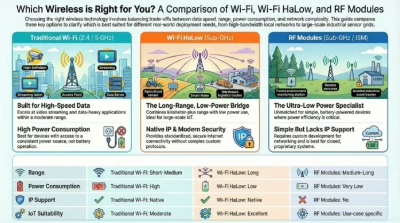
Wi-Fi HaLow vs Wi-Fi vs RF Modules: Selecting the Right Technology for Your Application
Wi-Fi HaLow vs Wi-Fi vs RF modules explained — compare range, power consumption, IP support, and scalability to choose the right wireless technology for industrial IoT.
Metrics to Mastery: The Hidden Engineering that drives Vizmonet Radio’s Performance
Vizmonet radio performance metrics explained — TX power, RX sensitivity, EVM, and interference handling that improve wireless range, stability, and real-world throughput.
OEM Checklist: How to Choose the Right Wireless Module Supplier
A practical OEM checklist to evaluate a wireless module supplier before selection, covering compliance, quality, cost, and long-term reliability.
Vizmonet’s Approach to Global Regulatory Compliance and Homologation
Learn how Vizmonet ensures global regulatory compliance and homologation through structured processes, expert oversight, and region-ready documentation.
OEM Guide to Industrial RF Wireless Transceiver Modules | Vizmonet
A practical OEM guide to selecting and integrating industrial RF and wireless transceiver modules. Learn how to manage RF performance, power, compliance, and environmental constraints to deliver reliable, high-performance wireless connectivity without costly redesigns.
SWaP-C Optimized Radio Module Design: Driving Next-Generation, Future-Ready Industrial Wireless Networks
Introduction Wireless connectivity is no longer optional—it’s essential. As cutting-edge innovations like UAVs, UAS, UGVs, UGS, and robotics reshape the industrial landscape, they unlock powerful new possibilities. But these advanced systems don’t just need...
Why Sub-1 GHz Wi-Fi HaLow Is Important for Industrial IoT | Vizmonet
Introduction Industrial IoT depends on stable, long-range, and energy-efficient wireless connectivity. Traditional Wi-Fi bands such as 2.4 GHz and 5 GHz often fail in harsh environments filled with metal structures, interference, and large coverage areas.Wi-Fi HaLow...