
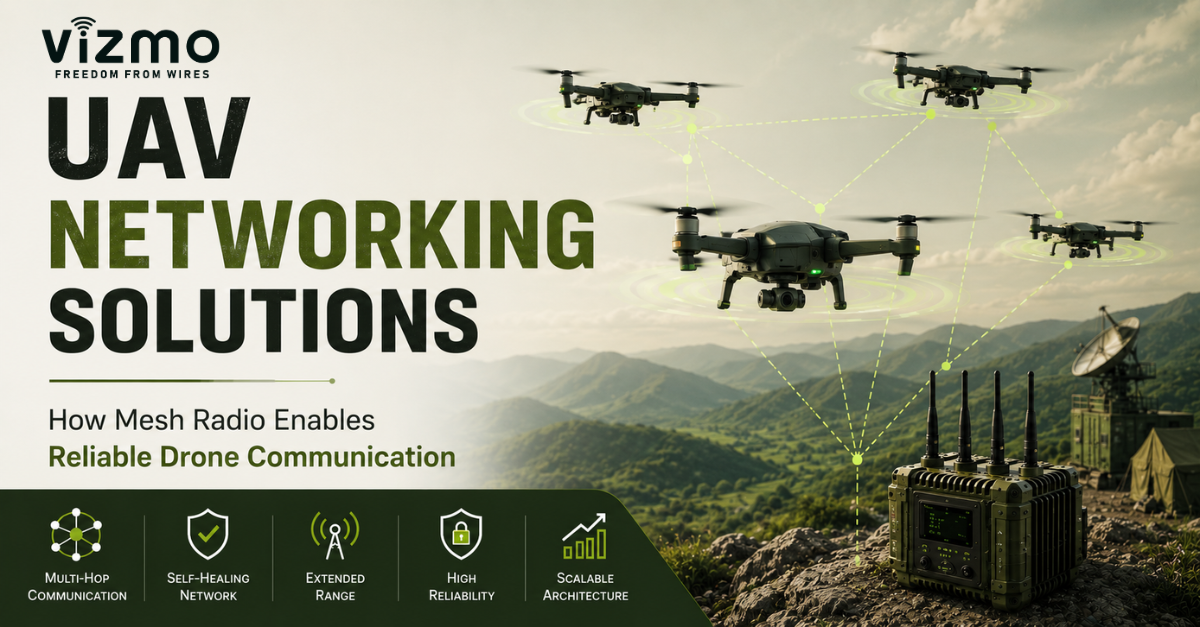
UAV Networking Solutions for Reliable Multi-Drone Communication
Reliable communication is the backbone of any Unmanned Aerial System (UAS) deployment. As drone operations scale across industrial inspection, defense, disaster response, and smart infrastructure, traditional point-to-point communication models often fail to deliver the required range, resilience, and reliability.
This is where UAV networking solutions based on mesh radio architecture play a critical role—enabling decentralized, self-healing communication networks that maintain connectivity even in dynamic and high-interference environments.
What are UAV Networking Solutions?
UAV networking solutions refer to communication architectures that enable multiple drones, ground stations, and control systems to operate within a unified network framework.
Unlike conventional single-link communication, these systems are designed to:
- Support multi-node connectivity
- Maintain communication across moving platforms
- Enable real-time data exchange between aerial and ground assets
- Ensure network continuity in complex environments
Modern UAV networks are increasingly built on mesh-based communication systems, which offer superior scalability and fault tolerance.
Limitations of Traditional Drone Communication Systems
Conventional UAV communication systems rely heavily on point-to-point RF or Wi-Fi links, which introduce several constraints:
Single Point of Failure
If the primary communication link is disrupted, the UAV may lose connectivity entirely.
Limited Operational Range
Direct communication between drone and ground station restricts range, especially in obstructed environments.
Poor Scalability
Managing multiple drones with independent links becomes inefficient and unreliable.
Susceptibility to RF Interference
Dense RF environments degrade signal quality, leading to unstable communication.
These limitations highlight the need for advanced networking architectures that can adapt to real-world operational demands.
What is Mesh Networking in UAV Systems?
Mesh networking is a distributed communication model where each UAV or node acts as both a transmitter and receiver, forming a self-organizing and self-healing network.
In a drone mesh network:
- Each node communicates with multiple neighboring nodes
- Data is routed dynamically through the most efficient path
- Network reliability improves as more nodes are added
This architecture eliminates dependency on a single communication link and significantly enhances network resilience and coverage.
How Mesh Radio Enables Reliable Drone Communication
Mesh radio systems are specifically designed to support dynamic, multi-node communication environments.
1. Multi-Hop Communication
Extends operational range by allowing data to travel across multiple nodes instead of relying on direct links.
2. Self-Healing Network Topology
Automatically reroutes data if a node fails or moves out of range, ensuring uninterrupted connectivity.
3. Adaptive Routing
Optimizes data paths in real time based on signal strength, interference levels, and network conditions.
4. High Network Resilience
Maintains communication integrity even in harsh or interference-heavy environments.
5. Scalable Architecture
Supports expanding UAV fleets without compromising network performance.
Use Cases of UAV Mesh Networking
Mesh-based UAV networking solutions are widely deployed in:
Industrial Inspection
Large-scale infrastructure inspections where drones operate across extended areas.
Defense & Tactical Operations
Secure, resilient communication for coordinated UAV missions in contested environments.
Disaster Response
Maintains connectivity in areas where traditional infrastructure is unavailable or damaged.
Smart Cities & Surveillance
Supports distributed drone networks for monitoring and data collection.
Agriculture & Remote Monitoring
Enables wide-area coverage across farms and isolated facilities.
Key Considerations When Choosing UAV Networking Solutions
When designing or selecting UAV networking systems, organizations should evaluate:
- Latency requirements for real-time control
- Throughput needs for video and sensor data
- RF environment conditions (interference levels)
- Scalability for multi-UAV operations
- Security requirements for sensitive data
Selecting the right architecture is critical for ensuring operational reliability and long-term scalability.
How Vizmonet Enables Advanced UAV Networking
Vizmonet’s UAV networking solutions are engineered with a system-level approach, combining RF expertise with advanced networking capabilities.
Core Advantages:
- Mesh-enabled wireless platforms for resilient communication
- High-performance RF design for extended range and signal stability
- Interference mitigation techniques for reliable operation in dense RF environments
- Multi-radio architectures for redundancy and failover
- Secure communication frameworks for mission-critical deployments
- SWaP-C-optimized radio modules are engineered for effortless integration with UAVs, minimizing size, weight, power, and cost constraints.
These capabilities enable organizations to deploy scalable, high-reliability UAV networks tailored for complex operational scenarios.
Conclusion
As UAV deployments evolve from isolated operations to networked, multi-drone ecosystems, traditional communication models are no longer sufficient.
Mesh-based UAV networking solutions provide the resilience, scalability, and reliability required for modern drone operations. By adopting advanced networking architectures, organizations can ensure consistent connectivity, enhanced operational efficiency, and improved mission outcomes.