
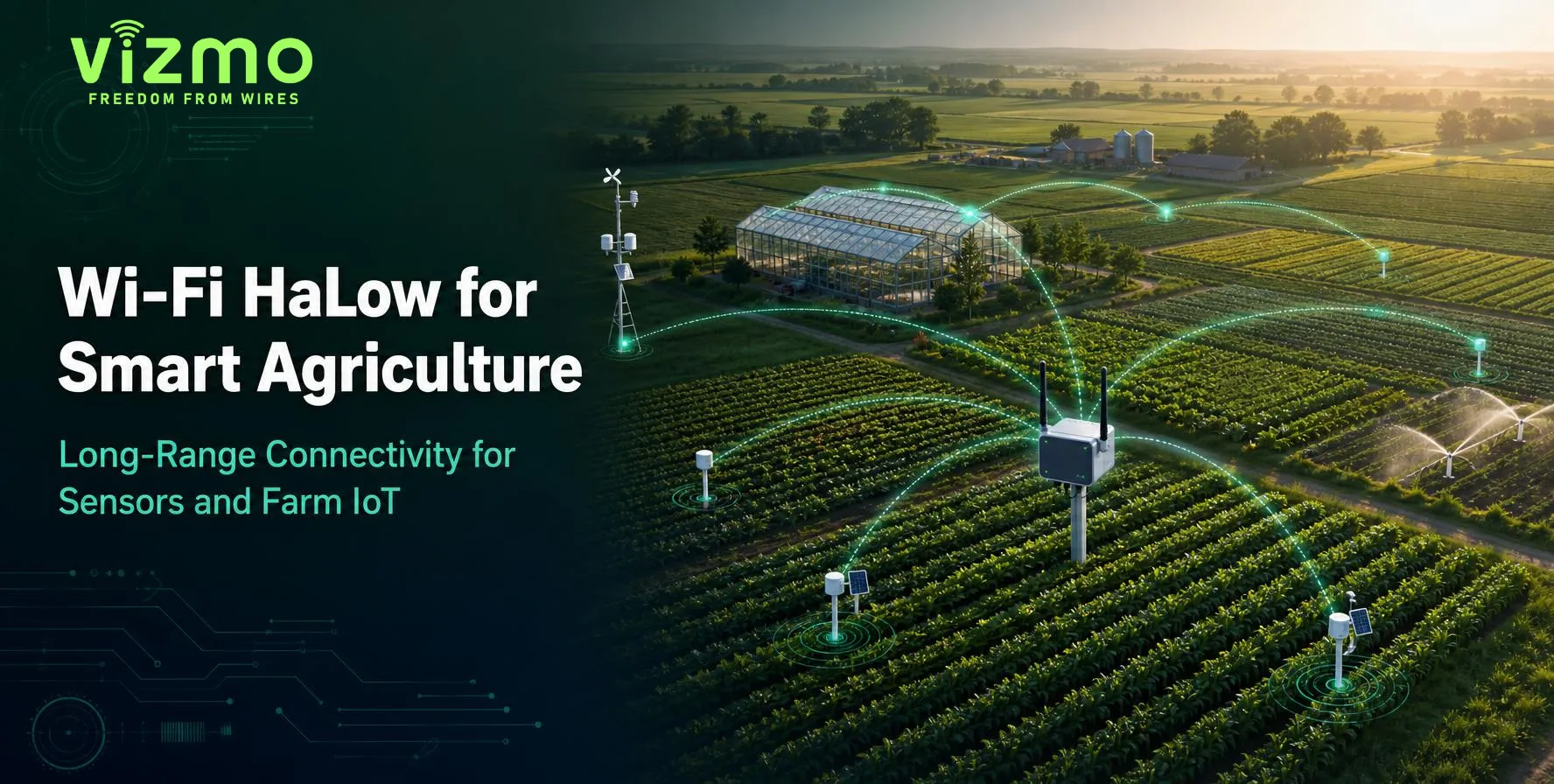
Wi-Fi HaLow for Smart Agriculture: Long-Range Connectivity for Sensors and Farm IoT
Smart agriculture depends on reliable communication between sensors, irrigation controllers, monitoring equipment, and connected farm systems. However, traditional Wi-Fi networks can struggle to provide coverage across large agricultural fields, plantations, and remote farming locations.
Wi-Fi HaLow (IEEE 802.11ah) offers an alternative for agricultural Internet of Things (IoT) networks. By operating in Sub-GHz frequency bands, it provides propagation characteristics suited to connecting devices across wider outdoor areas while supporting energy-efficient, IP-based communication.
For agricultural equipment manufacturers and IoT developers, Wi-Fi HaLow creates opportunities to build connected farming systems that require fewer wireless infrastructure points, depending on the environment and network design.
This guide explains how Wi-Fi HaLow works in agriculture, its practical applications, important deployment considerations, and how Vizmonet’s wireless products can support agricultural IoT development.
What Is Wi-Fi HaLow in Smart Agriculture?
Wi-Fi HaLow is a wireless networking technology based on the IEEE 802.11ah standard. It was developed to support long-range, energy-efficient communication for connected devices, sensors, and IoT systems.
Unlike conventional Wi-Fi operating at 2.4 GHz, 5 GHz, or 6 GHz, Wi-Fi HaLow operates in Sub-GHz spectrum, with the available frequency bands depending on regional regulations.
In agriculture, this makes it a useful technology to evaluate when sensors and connected devices are distributed across fields, greenhouses, irrigation infrastructure, and remote monitoring locations.
A Wi-Fi HaLow agricultural network can connect suitable devices to a central access point, allowing sensor information to reach a local gateway or monitoring system. With an appropriate internet backhaul, the data can also be forwarded to cloud-based agricultural platforms.
Why Traditional Wi-Fi Can Be Challenging for Farm IoT
Agricultural environments create wireless communication challenges that are different from those found in offices or residential buildings.
Large Agricultural Coverage Areas
Farms and plantations may extend across significant distances. Connecting sensors at opposite ends of a field using conventional Wi-Fi can require additional access points, cabling, or wireless repeaters.
Vegetation and Physical Obstacles
Trees, growing crops, farm buildings, equipment, and uneven terrain can affect wireless propagation. Signal quality may change as vegetation grows or equipment moves.
Remote Locations
Agricultural sensors may be installed far from existing network infrastructure. Expanding wired communication to these locations can increase installation complexity.
Power-Constrained Sensor Devices
Some agricultural IoT devices operate using batteries or solar-powered systems. Wireless communication must be designed carefully to meet the device’s energy budget.
Environmental Conditions
Outdoor wireless equipment must operate under varying temperatures, moisture levels, dust exposure, and seasonal weather conditions.
Wi-Fi HaLow can help address several connectivity challenges, but successful deployment still depends on antenna placement, link-budget planning, compliant RF operation, and appropriate hardware protection.
Key Benefits of Wi-Fi HaLow for Smart Farming
1. Extended Wireless Coverage
Wi-Fi HaLow uses lower-frequency radio signals that can provide better propagation characteristics than conventional higher-frequency Wi-Fi.
This makes it useful for connecting monitoring devices distributed across larger agricultural areas.
Actual coverage depends on transmit power, receiver sensitivity, antennas, terrain, vegetation, interference, and regional regulations.
2. Energy-Efficient Communication
Wi-Fi HaLow includes mechanisms designed to reduce power consumption in IoT networks.
Devices that transmit measurements periodically can use suitable power-management strategies to reduce unnecessary radio activity.
Actual battery life depends on hardware power consumption, firmware behavior, transmission intervals, and operating conditions.
3. IP-Based Connectivity
Wi-Fi HaLow supports IP-based networking, simplifying integration with compatible gateways, monitoring applications, and other networked systems.
This can be valuable for agricultural OEMs developing products that communicate with established IT and IoT infrastructure.
4. Support for Multiple Connected Devices
Agricultural networks may contain soil sensors, weather stations, irrigation equipment, and environmental monitoring devices.
Wi-Fi HaLow is designed to support many connected stations through an access-point-based architecture.
However, practical network capacity must be evaluated against traffic volume, reporting frequency, channel bandwidth, and access-point capabilities.
5. Flexible Deployment Architecture
Wi-Fi HaLow can be evaluated for standalone agricultural sensor networks, local edge-monitoring systems, and wireless gateway architectures.
It can also form part of a larger agricultural connectivity solution that combines different wireless technologies according to application requirements.
Practical Applications of Wi-Fi HaLow in Agriculture
Soil Moisture and Environmental Monitoring
Soil moisture sensors help agricultural operators understand field conditions and make more informed irrigation decisions.
A connected monitoring system may collect:
- Soil moisture measurements
- Soil temperature readings
- Ambient temperature and humidity
- Environmental conditions across different field zones
Wi-Fi HaLow can be evaluated as the wireless communication layer between compatible field devices and a central monitoring gateway.
Smart Irrigation Monitoring and Control
Modern irrigation systems use sensors and controllers to support water-management decisions.
Connected irrigation equipment can help operators monitor soil conditions, water flow, pump operation, and irrigation schedules.
A suitably designed Wi-Fi HaLow network can carry monitoring data and control messages between agricultural devices and a supervisory system.
Safety-critical functions should retain appropriate local control and fail-safe behavior rather than depending entirely on wireless connectivity.
Greenhouse Monitoring
Greenhouses require continuous observation of environmental parameters.
Connected sensors may monitor temperature, humidity, soil conditions, and equipment status.
Wi-Fi HaLow can support communication between compatible monitoring devices, particularly where structures or installation distances make conventional Wi-Fi coverage difficult.
Livestock and Agricultural Asset Monitoring
Wireless connectivity can support livestock-related monitoring infrastructure, equipment condition monitoring, and fixed agricultural asset sensors.
For mobile devices, engineers must evaluate coverage continuity, antenna orientation, movement, and power requirements.
Farm Equipment and Pump Monitoring
Agricultural pumps, water tanks, irrigation infrastructure, and remote equipment may be installed across widely separated locations.
Wireless monitoring can help operators collect operational information without visiting every equipment location.
Wi-Fi HaLow can be considered for these applications when its network characteristics match the required reporting interval, data volume, and coverage.
How a Wi-Fi HaLow Agricultural IoT Network Works
A typical agricultural monitoring architecture can be organized into four layers.
1. Sensor Layer
Field sensors collect information such as soil moisture, temperature, humidity, water level, or equipment status.
2. Embedded Wireless Layer
A compatible embedded controller and Wi-Fi HaLow radio provide wireless communication between the field device and the network.
3. Access Point or Gateway Layer
A Wi-Fi HaLow access point receives information from connected devices. A local gateway can process data or forward it to another network.
4. Monitoring and Application Layer
Agricultural monitoring software displays measurements, generates alerts, stores historical information, or supports irrigation-management workflows.
For wider deployments, engineers may require additional access points, suitable backhaul connectivity, or other wireless technologies.
The complete architecture should be designed around the farm’s physical layout, traffic requirements, and available infrastructure.
For a broader understanding of connected farming environments, explore Vizmonet’s Agriculture Applications.
Vizmonet ahSP1 Wi-Fi HaLow Module for Agricultural IoT Development
Agricultural IoT manufacturers developing connected devices need hardware that can support their wireless communication requirements.
Vizmonet offers the ahSP1 Wi-Fi HaLow module, an IEEE 802.11ah extension board designed for the Sony SPRESENSE platform.
The ahSP1 uses the Newracom NRC7292 chipset and supports Sub-GHz wireless development for industrial and embedded IoT applications.
Key Features of the ahSP1 Module
- IEEE 802.11ah Wi-Fi HaLow technology
- Newracom NRC7292 chipset
- Sony SPRESENSE extension-board architecture
- 1 MHz, 2 MHz, and 4 MHz channel bandwidth support
- Region-dependent Sub-GHz frequency configurations
- Industrial operating-temperature specification of -40°C to +85°C
The ahSP1 is suitable for engineering evaluation of distributed agricultural sensor systems and compatible embedded wireless designs.
Development teams can use the platform to investigate RF coverage, sensor-data communication, host integration, and application-specific network behavior before selecting a production architecture.
Explore the Vizmonet ahSP1 Wi-Fi HaLow Module
Alternative Sub-GHz Wi-Fi Modules for Agricultural OEMs
Wi-Fi HaLow is not the only Sub-GHz wireless technology that agricultural equipment manufacturers can evaluate.
Vizmonet also offers nE1-902 and nE2-902 MiniPCIe wireless modules that use IEEE 802.11b/g/n-based Wi-Fi technology in the 902-928 MHz band.
These modules are technically distinct from IEEE 802.11ah Wi-Fi HaLow.
nE1-902: 1×1 Sub-GHz Wi-Fi Module
The Vizmonet nE1-902 is a 1×1 SISO MiniPCIe wireless module intended for compatible 900 MHz wireless designs.
It can be evaluated for agricultural OEM systems requiring a MiniPCIe interface and the module’s supported wireless architecture.
nE2-902: 2×2 Sub-GHz Wi-Fi Module
The Vizmonet nE2-902 supports a 2×2 MIMO radio configuration and MiniPCIe integration.
It can be considered for agricultural wireless equipment requiring its supported radio architecture and interface capabilities.
Choosing Between the Modules
The appropriate wireless module depends on:
- Required wireless standard and interoperability
- Operating region and permitted frequencies
- Host processor and hardware interface
- Antenna configuration
- Power consumption and supply requirements
- Link-budget and coverage requirements
- Application data rate and latency
Important: nE1-902 and nE2-902 are not IEEE 802.11ah Wi-Fi HaLow modules. Engineers should not assume interoperability with ahSP1 without a separately validated gateway or protocol-conversion architecture.
How to Plan a Reliable Wi-Fi HaLow Network for Agriculture
Wireless performance depends on more than the selected radio module.
Before deployment, agricultural IoT developers should evaluate the following factors.
Farm Layout and Coverage
Map sensor locations, field boundaries, buildings, trees, and other potential obstructions.
Identify suitable locations for wireless access points and gateways.
Antenna Selection and Placement
Select antennas according to the operating frequency, required coverage pattern, installation environment, and applicable RF limits.
Evaluate antenna height and positioning, especially where vegetation or terrain may obstruct radio paths.
RF Link Budget
Estimate the relationship between transmit power, antenna gains, path loss, receiver sensitivity, and system losses.
A calculated link margin helps engineers evaluate whether communication is likely to remain reliable under expected operating conditions.
Vizmonet provides an RF Link Planner to support preliminary wireless network evaluation.
Sensor Power Requirements
Determine how often each device must transmit information and how long the device is expected to operate without maintenance.
Evaluate the complete hardware and firmware power budget instead of relying only on the wireless standard’s energy-efficiency features.
Regional Frequency Regulations
Wi-Fi HaLow frequency availability is not identical worldwide.
Engineers must select the appropriate hardware configuration and confirm that the planned operation complies with the regulations of the deployment country.
Field Validation
Perform practical measurements at representative locations before finalizing the deployment.
Testing should include realistic vegetation conditions, device mounting positions, operating temperatures, traffic levels, and expected environmental changes.
For more engineering background, read Vizmonet’s IEEE 802.11ah Wi-Fi HaLow guide.
Embedded Wireless Integration for Agricultural OEMs
Selecting a wireless module is only one stage of developing a connected agricultural product.
Equipment manufacturers may also need support with embedded hardware design, antenna integration, firmware compatibility, RF validation, and regulatory planning.
Vizmonet provides RF and wireless engineering services for OEMs developing industrial IoT and embedded wireless products.
Its engineering capabilities include:
- Wireless architecture and module selection
- Embedded hardware and system integration
- RF and antenna engineering
- Prototype development and validation
- Product integration and manufacturing support
- Regulatory approval and certification planning
For agricultural IoT manufacturers, these services can support the development of connected monitoring devices, wireless gateways, and application-specific embedded systems.
Explore Vizmonet RF and Wireless Engineering Services
Frequently Asked Questions About Wi-Fi HaLow Agriculture
1. What is Wi-Fi HaLow used for in agriculture?
Wi-Fi HaLow can be used to connect compatible agricultural IoT devices, including soil sensors, weather monitoring equipment, irrigation infrastructure, and distributed environmental monitoring systems.
2. Is Wi-Fi HaLow suitable for large farms?
Wi-Fi HaLow is designed for long-range IoT communication and can be evaluated for large agricultural environments. Actual coverage depends on terrain, vegetation, antenna placement, network equipment, and regional transmission limits.
3. Can Wi-Fi HaLow support battery-powered agricultural sensors?
Yes. The standard includes energy-saving mechanisms suitable for IoT designs. However, achievable battery life depends on the selected hardware, reporting intervals, firmware, and device power budget.
4. Is Wi-Fi HaLow better than LoRaWAN for agriculture?
Neither technology is universally better. Wi-Fi HaLow provides IP-based Wi-Fi connectivity and supports different data-rate requirements, while LoRaWAN is commonly selected for very low-data-rate, low-power sensing networks. The choice depends on application requirements.
For a detailed comparison, read Wi-Fi HaLow vs LoRaWAN for Industrial IoT.
5. Which Vizmonet product supports Wi-Fi HaLow development?
Vizmonet’s ahSP1 is an IEEE 802.11ah Wi-Fi HaLow extension board for Sony SPRESENSE, suitable for evaluating compatible agricultural and industrial IoT applications.
6. Can Vizmonet assist with agricultural IoT product integration?
Yes. Vizmonet provides RF engineering and OEM wireless product-development services, including hardware integration, antenna planning, RF validation, and regulatory support.
Conclusion: Building Connected Agriculture With Wi-Fi HaLow
Smart agriculture requires wireless networks that can connect distributed sensors, monitoring equipment, and farm infrastructure across challenging outdoor environments.
Wi-Fi HaLow provides an IEEE 802.11ah-based connectivity option for agricultural IoT systems where extended coverage, energy efficiency, and IP-based communication are important.
For developers evaluating Wi-Fi HaLow, Vizmonet’s ahSP1 provides a hardware platform for Sony SPRESENSE-based development. Its nE1-902 and nE2-902 modules offer different Sub-GHz wireless options for compatible OEM architectures.
Successful agricultural connectivity depends on selecting the right wireless technology, planning the RF network carefully, and validating performance under actual field conditions.
Start Your Agricultural IoT Wireless Project With Vizmonet
Developing a connected agricultural sensor, irrigation monitoring system, or embedded farm IoT product?
Explore the ahSP1 Wi-Fi HaLow Module or discuss your requirements with Vizmonet’s wireless engineering team to evaluate a suitable connectivity and integration approach.