
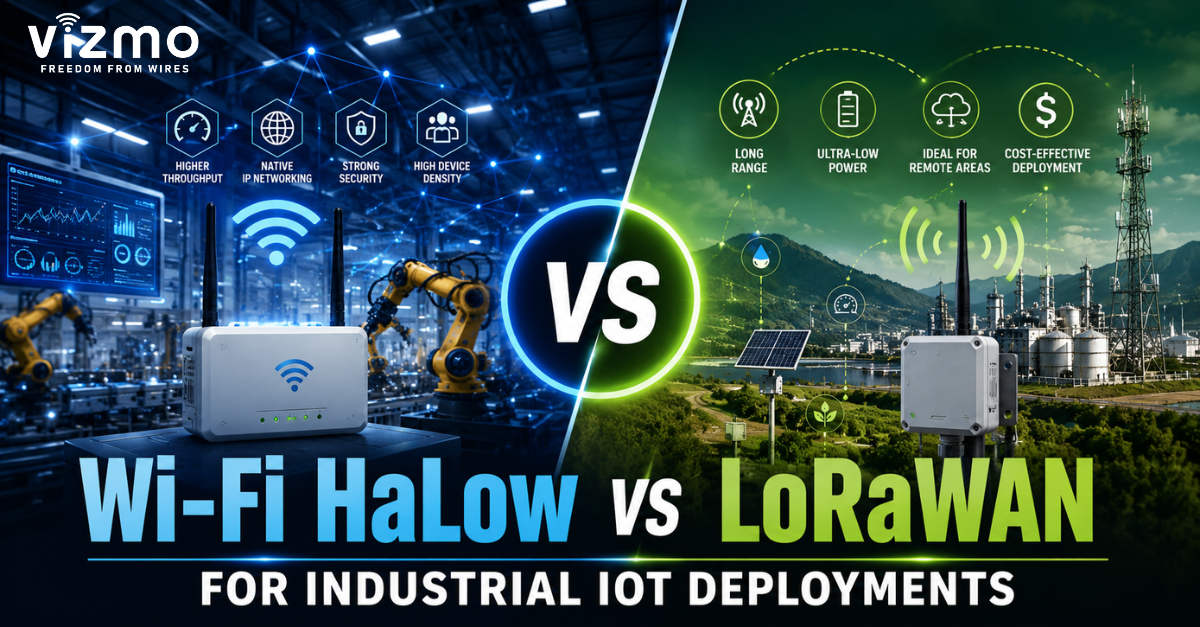
Wi-Fi HaLow vs LoRaWAN for Industrial IoT Deployments: Which Technology Is Right for Your Application?
Industrial IoT (IIoT) is transforming how organizations monitor assets, automate processes, improve safety, and optimize operations. From smart manufacturing facilities and utility networks to mining sites and transportation infrastructure, reliable wireless connectivity has become a critical component of digital transformation initiatives.
However, selecting the right wireless technology remains one of the most important decisions in any Industrial IoT deployment.
Among the most discussed technologies today are Wi-Fi HaLow and LoRaWAN. Both are designed to support long-range wireless communication and low-power IoT applications, yet they differ significantly in architecture, performance, throughput, and deployment models.
Understanding the strengths and limitations of each technology helps OEMs, system integrators, and industrial operators make informed decisions when designing future-ready Industrial IoT networks.
Understanding Industrial IoT Connectivity Requirements
Before comparing Wi-Fi HaLow and LoRaWAN, it’s important to understand what Industrial IoT deployments typically require.
Industrial environments often demand:
- Long-range wireless coverage
- Low power consumption
- Reliable connectivity
- Scalability for thousands of devices
- Secure communication
- Real-time monitoring
- Low infrastructure costs
- Regulatory compliance
- Integration with existing IP networks
The relative importance of these requirements varies depending on the application.
For example:
- Smart meters prioritize battery life.
- Factory automation prioritizes latency and reliability.
- Asset tracking focuses on coverage and mobility.
- Video monitoring requires higher throughput.
This is why there is no universal “best” technology for every Industrial IoT deployment.
What Is Wi-Fi HaLow?
Wi-Fi HaLow is based on the IEEE 802.11ah wireless networking standard.
Unlike traditional Wi-Fi technologies that operate in 2.4 GHz, 5 GHz, and 6 GHz bands, Wi-Fi HaLow uses Sub-GHz frequencies, enabling:
- Extended range
- Better signal penetration
- Lower power consumption
- Native IP networking
- Higher device density
Wi-Fi HaLow was specifically developed to bridge the gap between conventional Wi-Fi and low-power IoT communication technologies.
Key Benefits of Wi-Fi HaLow
- Long-range communication
- Native IPv4 and IPv6 support
- Strong Wi-Fi security standards
- Better wall and obstacle penetration
- Higher throughput than many LPWAN technologies
- Direct integration with enterprise networks
These capabilities make Wi-Fi HaLow attractive for Industrial IoT connectivity where both coverage and data throughput matter.
Organizations evaluating Industrial IoT wireless technologies can explore Vizmonet’s AHSP1 Wi-Fi HaLow Module, designed to deliver long-range connectivity for Industrial OEM applications.
To better understand how Sub-GHz wireless communication improves coverage and penetration, read Why Sub-1 GHz Wi-Fi HaLow Is Important.
Additional information about interoperability and certification can be found through the Wi-Fi CERTIFIED HaLow Program.
What Is LoRaWAN?
LoRaWAN (Long Range Wide Area Network) is a Low Power Wide Area Network (LPWAN) protocol built on LoRa radio technology.
LoRaWAN is optimized for:
- Ultra-low power consumption
- Very long-range communication
- Small packet transmissions
- Battery-powered IoT devices
Rather than functioning like a traditional IP network, LoRaWAN relies on gateways that collect sensor data and forward it to network servers.
Key Benefits of LoRaWAN
- Extremely long range
- Multi-year battery life
- Low infrastructure requirements
- Cost-effective sensor deployments
- Excellent support for remote monitoring
LoRaWAN has become widely adopted for smart city, utility, agriculture, and environmental monitoring applications.
Wi-Fi HaLow vs LoRaWAN: Technology Comparison
Frequency Bands
| Feature | Wi-Fi HaLow | LoRaWAN |
|---|---|---|
| Standard | IEEE 802.11ah | LoRaWAN |
| Frequency | Sub-GHz | Sub-GHz |
| Regional Operation | Yes | Yes |
| Industrial Suitability | High | High |
Both technologies operate in Sub-GHz spectrum, which contributes to their long-range capabilities. Organizations evaluating long-range Industrial IoT connectivity can compare Wi-Fi HaLow with traditional wireless technologies in Vizmonet’s guide on Wi-Fi HaLow vs Wi-Fi vs RF Modules.
For additional technical background on wireless standards and spectrum allocation, refer to the IEEE Standards Association.
Range Comparison
Range is one of the primary reasons organizations evaluate either technology.
| Environment | Wi-Fi HaLow | LoRaWAN |
|---|---|---|
| Industrial Facility | Hundreds of meters to 1 km | Several kilometers |
| Warehouse | Up to 1 km | Several kilometers |
| Open Outdoor Area | Multiple kilometers | Up to 15 km or more |
Engineers planning long-range wireless deployments can use Vizmonet’s RF Link Planner and RF Link Budget Calculation Guide to estimate coverage requirements and optimize network design.
Winner: LoRaWAN
For maximum communication distance, LoRaWAN typically offers greater range.
However, range alone does not determine overall network performance.
When evaluating wireless technologies for Industrial IoT, organizations should consider not only communication distance but also throughput, latency, power consumption, integration complexity, and long-term scalability.
Throughput Comparison
Throughput is often where the biggest difference appears.
| Feature | Wi-Fi HaLow | LoRaWAN |
|---|---|---|
| Data Rate | Higher | Lower |
| Firmware Updates | Supported | Limited |
| Image Transfer | Practical | Difficult |
| Video Streaming | Possible | Not Suitable |
Winner: Wi-Fi HaLow
Applications requiring larger data transfers benefit significantly from Wi-Fi HaLow.
Examples include:
- Industrial cameras
- Equipment diagnostics
- Firmware updates
- Edge computing systems
- Wireless HMIs
Organizations developing high-bandwidth Industrial IoT applications can explore Vizmonet’s wireless product portfolio, including Wi-Fi 6 and Wi-Fi 6E modules for throughput-intensive deployments.
Power Consumption Comparison
Battery life is often critical in Industrial IoT deployments.
| Feature | Wi-Fi HaLow | LoRaWAN |
|---|---|---|
| Power Efficiency | High | Extremely High |
| Multi-Year Battery Life | Possible | Common |
| Sleep Modes | Yes | Yes |
Winner: LoRaWAN
For ultra-low-power sensor applications, LoRaWAN generally offers longer battery life.
This makes it ideal for:
- Smart metering
- Environmental sensors
- Utility monitoring
- Agricultural monitoring
However, Wi-Fi HaLow provides an effective balance between power efficiency and throughput, making it attractive for Industrial IoT deployments that require both connectivity performance and extended battery life.
Network Architecture Comparison
Wi-Fi HaLow
Wi-Fi HaLow supports direct IP connectivity.
Benefits include:
- Simplified integration
- Familiar Wi-Fi ecosystem
- Easier enterprise deployment
- Standard networking tools
Industrial OEMs building connected products can leverage Vizmonet’s RF Engineering Services and wireless connectivity expertise to accelerate development and deployment.
LoRaWAN
LoRaWAN requires:
- Gateways
- Network servers
- Application servers
Benefits include:
- Efficient large-scale sensor deployments
- Minimal endpoint power consumption
Winner: Wi-Fi HaLow
Organizations with existing IP infrastructure often find Wi-Fi HaLow easier to integrate.
The native IP architecture enables seamless integration with enterprise systems, cloud platforms, industrial automation environments, and edge computing applications.
For organizations developing custom Industrial IoT solutions, Vizmonet also provides custom wireless system development, embedded systems engineering, manufacturing support, and product certification services.
For additional information about industrial wireless networking standards and architectures, visit the Wi-Fi Alliance.
Scalability Comparison
Industrial IoT deployments often require support for hundreds, thousands, or even tens of thousands of connected devices.
| Feature | Wi-Fi HaLow | LoRaWAN |
|---|---|---|
| Device Density | High | Very High |
| Large Deployments | Excellent | Excellent |
| Industrial Scaling | Strong | Strong |
Result: Tie
Both technologies are capable of supporting large Industrial IoT deployments when properly designed.
Successful scaling depends on network architecture, RF planning, device management strategies, and application requirements. Organizations planning large-scale deployments can leverage Vizmonet’s RF Link Planner and wireless engineering services to optimize network performance.
Security Comparison
Security is increasingly important as critical infrastructure becomes more connected.
Wi-Fi HaLow Security
Benefits include:
- WPA3 support
- Standard Wi-Fi security framework
- Enterprise-grade authentication
- Secure IP communication
LoRaWAN Security
Benefits include:
- End-to-end encryption
- Device authentication
- Network authentication
Result: Tie
Both technologies offer strong security mechanisms when implemented correctly. Security design should include device authentication, encrypted communications, secure firmware updates, and regulatory compliance requirements.
For products targeting global markets, organizations should also consider global regulatory compliance and homologation requirements during development.
Industrial Application Comparison
The ideal wireless technology depends heavily on the intended Industrial IoT application.
Smart Manufacturing
Requirements:
- Low latency
- Equipment monitoring
- Predictive maintenance
- Industrial automation
Recommended Technology: Wi-Fi HaLow
Its higher throughput and IP-native architecture make it well suited for factory environments. Manufacturers implementing connected operations can explore Vizmonet’s Industry 4.0 Applications solutions.
Mining Operations
Requirements:
- Long-range connectivity
- Mobile equipment support
- Harsh environment operation
Recommended Technology: Wi-Fi HaLow or LoRaWAN
Selection depends on whether the application prioritizes data throughput or battery life. Learn how industrial wireless networks support Mining Applications.
Oil & Gas Facilities
Requirements:
- Remote monitoring
- Pipeline monitoring
- Safety systems
Recommended Technology: LoRaWAN
Long-range monitoring applications often benefit from LoRaWAN’s power efficiency. Explore Vizmonet’s expertise in Oil & Gas Applications.
Smart Utilities
Requirements:
- Smart metering
- Asset monitoring
- Wide-area coverage
Recommended Technology: LoRaWAN
Many utility deployments prioritize battery life over throughput.
Smart Warehousing
Requirements:
- Asset tracking
- Inventory monitoring
- Connected equipment
Recommended Technology: Wi-Fi HaLow
Higher bandwidth and IP compatibility provide significant operational advantages.
Industrial wireless technologies are also widely used in Unmanned Ground Systems, Unmanned Aerial Systems, logistics networks, and mission-critical public infrastructure.
For additional guidance on securing connected industrial systems, refer to the National Institute of Standards and Technology (NIST) cybersecurity resources.
When Should You Choose Wi-Fi HaLow?
Wi-Fi HaLow is often the better choice when:
- IP networking is required
- Higher data rates are needed
- Firmware updates occur regularly
- Device-to-device communication is important
- Existing Wi-Fi infrastructure is leveraged
- Future scalability is a priority
Common applications include:
- Industrial automation
- Smart factories
- Autonomous systems
- Connected machinery
- Industrial wireless networks
- Smart infrastructure
Organizations building advanced Industrial IoT solutions can leverage Vizmonet’s Wi-Fi HaLow solutions and wireless engineering services to accelerate development and deployment.
For OEMs developing wireless-enabled products, the AHSP1 Wi-Fi HaLow Module provides a practical platform for implementing long-range Industrial IoT connectivity.
When Should You Choose LoRaWAN?
LoRaWAN is often the better choice when:
- Battery life is the top priority
- Data packets are very small
- Devices transmit infrequently
- Extremely long range is required
- Infrastructure costs must remain low
Common applications include:
- Smart metering
- Environmental monitoring
- Agriculture
- Utility networks
- Asset monitoring
- Remote sensing
Many Industrial IoT deployments use LoRaWAN for sensor monitoring while leveraging Wi-Fi HaLow or traditional Wi-Fi solutions for higher-bandwidth applications.
The Future of Industrial Wireless Connectivity
Rather than competing directly, Wi-Fi HaLow and LoRaWAN increasingly complement one another.
Many Industrial IoT deployments use both technologies simultaneously.
For example:
- LoRaWAN handles low-power sensor networks.
- Wi-Fi HaLow supports higher-bandwidth operational systems.
This hybrid approach enables organizations to optimize performance, battery life, coverage, and cost across different use cases.
As Industrial IoT ecosystems continue to expand, organizations are increasingly adopting multi-layer connectivity strategies that combine Wi-Fi HaLow, LoRaWAN, Wi-Fi 6, Wi-Fi 6E, RF modules, and edge computing technologies.
Vizmonet supports this evolution through its portfolio of wireless products, embedded wireless systems, and custom connectivity solutions designed for mission-critical Industrial OEM applications.
Engineers evaluating long-range wireless architectures can also review:
- Wi-Fi HaLow vs Wi-Fi vs RF Modules
- Why Sub-1 GHz Wi-Fi HaLow Is Important
- OEM Industrial RF Wireless Transceiver Module Guide
For broader wireless industry developments and standards information, visit the Wi-Fi Alliance.
Accelerating Industrial Wireless Development with Vizmonet
Choosing the right wireless technology is just the beginning of a successful Industrial IoT (IIoT) solution.
To bring a reliable product to market, OEMs must also solve complex challenges such as:
- RF performance optimization
- Hardware design and integration
- Embedded software development
- Regulatory compliance and certification
- Scalable manufacturing
- End-to-end product lifecycle management
How Vizmonet Adds Value
Vizmonet enables faster and more reliable product development by offering a comprehensive suite of industrial wireless engineering and manufacturing services.
- RF Engineering Services – Optimized performance for mission-critical applications
- Embedded Systems Development – Seamless hardware-software integration using advanced embedded wireless systems
- Custom Wireless System Development – Tailored designs for Industrial IoT use cases
- Original Design Manufacturing (ODM) – Concept-to-product expertise
- Turnkey Manufacturing Services – From prototyping to mass production
- PCB Assembly Manufacturing – High-quality, scalable manufacturing
- Box-Build Assembly – Complete system integration
- Regulatory Approvals and Product Certification – Faster market entry with compliance support
Whether you’re developing Industrial IoT gateways, wireless sensors, connected machines, autonomous systems, or mission-critical communications equipment, Vizmonet provides the expertise required to accelerate development while minimizing technical and regulatory risks.
Organizations evaluating wireless hardware partners can also review Vizmonet’s Wireless Module Supplier Checklist and explore the company’s portfolio of industrial wireless products.
For OEMs requiring advanced wireless connectivity, Vizmonet also offers:
- Mini PCIe Wi-Fi Radio Modules
- Embedded Wi-Fi System Modules
- Wi-Fi Transceiver Modules
- Industrial IoT Products
- Wi-Fi HaLow Solutions
Conclusion
The Wi-Fi HaLow vs LoRaWAN debate ultimately depends on application requirements.
LoRaWAN excels in ultra-low-power, long-range sensor networks where data transmission requirements are minimal. Wi-Fi HaLow, on the other hand, provides greater throughput, native IP connectivity, and stronger integration with modern Industrial IoT ecosystems.
For industrial automation, connected machinery, smart warehousing, and next-generation Industrial IoT deployments, Wi-Fi HaLow offers compelling advantages. For remote sensing, smart metering, and battery-powered monitoring systems, LoRaWAN remains an excellent choice.
Rather than viewing these technologies as direct competitors, many organizations are adopting hybrid connectivity architectures that leverage the strengths of both technologies.
Successful Industrial IoT deployments require more than selecting the right wireless protocol. They also depend on robust RF engineering, reliable hardware design, regulatory compliance, scalable manufacturing, and long-term product lifecycle support.
With expertise spanning wireless engineering services, embedded systems development, manufacturing, and certification, Vizmonet helps OEMs bring innovative Industrial IoT solutions to market faster and more efficiently.
As Industrial IoT continues to evolve, organizations that carefully align wireless technology selection with operational objectives will be best positioned to achieve scalable, secure, and future-ready connectivity.
For additional information on wireless connectivity standards and industry developments, visit the Wi-Fi Alliance.
FAQ: Wi-Fi HaLow vs LoRaWAN
1. What is the difference between Wi-Fi HaLow and LoRaWAN?
Wi-Fi HaLow provides higher throughput and native IP connectivity, while LoRaWAN focuses on ultra-low-power, long-range communication for sensor networks.
2. Which has better range, Wi-Fi HaLow or LoRaWAN?
LoRaWAN generally offers longer communication distances, particularly in outdoor environments.
3. Is Wi-Fi HaLow suitable for Industrial IoT?
Yes. Wi-Fi HaLow is designed specifically for Industrial IoT and supports long-range, secure, IP-based communication.
4. Does LoRaWAN consume less power than Wi-Fi HaLow?
In most deployments, LoRaWAN offers lower power consumption and longer battery life.
5. Can Wi-Fi HaLow and LoRaWAN be used together?
Yes. Many Industrial IoT deployments use both technologies to support different connectivity requirements across the same network.