
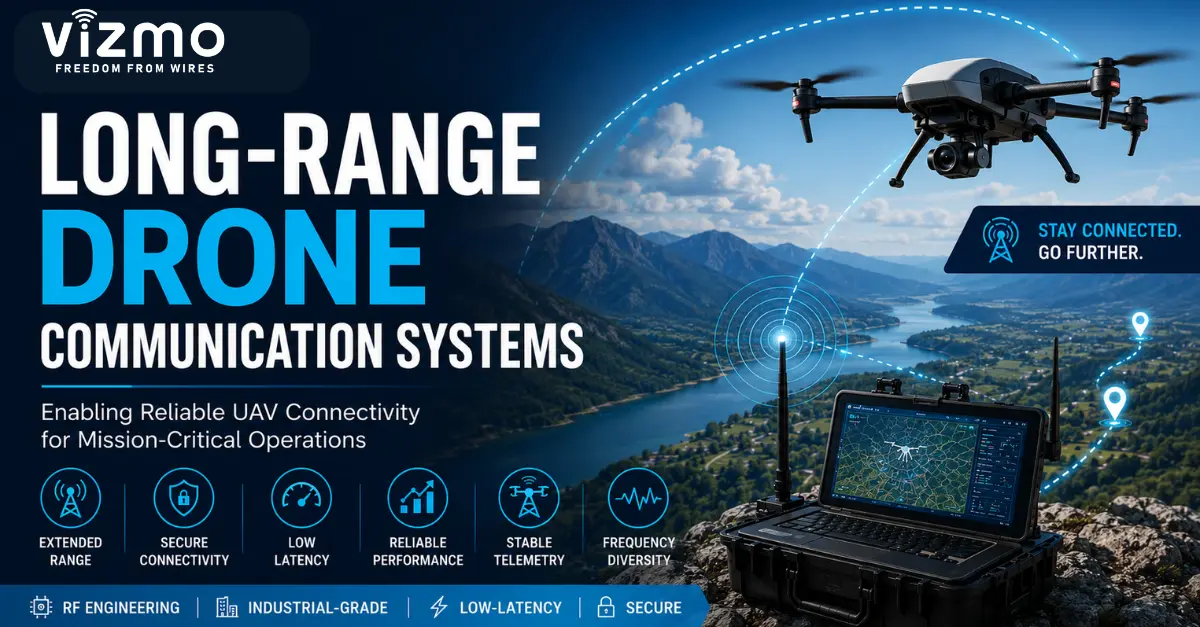
How UAV Communication Systems Enable Reliable Long-Range Drone Operations
Modern UAV systems are no longer limited to short-range recreational applications. Today, industrial drones, surveillance platforms, autonomous drone systems, and fixed-wing UAVs are expected to operate across vast distances while maintaining stable communication links in demanding environments.
Reliable UAV communication systems have become one of the most critical requirements for modern drone deployments. Whether used for industrial inspections, defense surveillance, agriculture, mapping, public safety, or autonomous missions, maintaining secure and uninterrupted connectivity directly impacts operational performance, safety, and mission success.
At Vizmonet, advanced RF engineering and wireless communication technologies support reliable UAV connectivity, long-range drone communication, and mission-critical communication for unmanned systems operating in challenging environments.
Why Long-Range Drone Connectivity Matters
The effectiveness of any long-range drone depends on its ability to maintain stable UAV communication links throughout flight operations. As operational distance increases, signal integrity becomes increasingly difficult to maintain due to interference, terrain obstructions, spectrum congestion, latency, and environmental conditions.
For industrial drones and autonomous UAV platforms, communication failures can result in:
- Loss of telemetry data
- Delayed command execution
- Navigation instability
- Reduced operational safety
- Mission interruptions
- Loss of situational awareness
Modern UAV communication systems are engineered to provide:
- Extended drone signal range
- Low-latency communication
- Secure wireless transmission
- Reliable telemetry performance
- High data throughput
- Resilient UAV communications
These capabilities are essential for Beyond Visual Line of Sight (BVLOS) operations and large-scale industrial UAV deployments.
Key Challenges in Long-Range Drone Communication
Signal Attenuation
As transmission distance increases, RF signal strength naturally decreases. Long-range drone communication requires optimized antennas, advanced RF communication modules, and efficient communication protocols to compensate for signal degradation.
Environmental Interference
Urban infrastructure, industrial machinery, electromagnetic noise, and competing wireless signals can interfere with drone communication systems. Reliable UAV connectivity requires advanced interference mitigation techniques and spectrum management.
Terrain Obstruction
Buildings, forests, mountains, and infrastructure can block communication pathways. UAV communication solutions often incorporate directional antennas and mesh networking technologies to maintain connectivity in remote environments.
Latency Sensitivity
Autonomous UAV platforms depend on low-latency communication for navigation, telemetry, and command execution. Delays can significantly impact flight stability and operational reliability.
Security Risks
Secure drone communication systems are essential for protecting sensitive industrial, government, and defense data from interception, jamming, and unauthorized access.
UAV Communication Links and Network Architecture
Reliable UAV communication links form the foundation of successful long-range drone operations. Every UAV communication system relies on a combination of RF hardware, antennas, network management technologies, telemetry systems, and software-defined communication protocols.
A modern unmanned aerial vehicle network must support:
- Continuous command and control
- Real-time telemetry exchange
- Video and sensor data transmission
- Mission-critical communications
- Low-latency UAV connectivity
As drone fleets become increasingly autonomous, communication for unmanned systems must deliver consistent performance across complex environments and long operational ranges.
Core Technologies Behind Reliable UAV Communication Systems
Advanced RF Communication Modules
High-performance RF communication modules form the foundation of modern UAV communication systems.
- Extended transmission distance
- Improved signal stability
- Higher receiver sensitivity
- Enhanced interference resistance
- Reliable drone wireless communication
Learn more about Vizmonet’s RF technologies:
RF Communication Modules
Directional Antenna Systems
Directional antennas improve long-range drone communication by focusing RF energy toward specific transmission paths.
- Extended communication range
- Improved signal quality
- Reduced packet loss
- Better spectrum efficiency
UAV Mesh Communication Systems
A UAV mesh communication system enables drones and ground nodes to dynamically relay signals across multiple communication paths.
Benefits include:
- Extended coverage areas
- Network redundancy
- Improved reliability
- Self-healing communication pathways
- Enhanced unmanned connectivity
LTE and 5G Integration
Modern UAV communication solutions increasingly integrate LTE and 5G technologies to support:
- High-bandwidth communications
- Real-time video streaming
- Cloud connectivity
- Remote fleet management
- Scalable UAV communications
Telemetry Communication Systems
Telemetry systems continuously exchange flight data, diagnostics, navigation information, and mission status between UAVs and control stations.
- Improved flight safety
- Operational awareness
- Predictive maintenance
- Mission coordination
Advanced Drone Communication Systems for Mission-Critical Applications
Advanced drone communication systems combine RF engineering, intelligent networking, telemetry systems, and secure communication technologies to support reliable operations in demanding environments.
These systems commonly incorporate:
- Multi-frequency UAV communications
- Frequency diversity
- Adaptive routing
- Mesh networking
- Secure communication protocols
- Low-latency data transmission
Advanced drone communication technology is increasingly deployed across industrial inspection, defense surveillance, public safety, and critical infrastructure monitoring applications.
Secure Drone Communication Systems
Secure drone communication systems help protect operational data against interference, signal interception, cyber threats, and unauthorized access.
Modern UAV communication solutions often include:
- End-to-end encryption
- Secure authentication
- Anti-jamming technologies
- Network redundancy
- Spectrum monitoring
- Adaptive frequency management
As drone deployments continue to expand, secure UAV communications are becoming increasingly important for mission success.
How RF Engineering Improves UAV Connectivity
RF engineering plays a critical role in improving UAV connectivity and long-range drone communication performance.
Key engineering considerations include:
- Frequency selection
- Frequency diversity
- Antenna gain optimization
- Signal filtering
- Spectrum efficiency
- Power management
- Advanced modulation techniques
- Noise reduction
At Vizmonet, RF engineering expertise supports reliable communication for unmanned systems operating in mission-critical environments.
Industrial Applications of UAV Communication Systems
Industrial Inspection
- Pipeline monitoring
- Powerline inspection
- Solar farm monitoring
- Oil and gas infrastructure assessment
Defense and Surveillance
Reliable UAV communication systems support real-time intelligence gathering, tactical operations, border monitoring, and situational awareness.
Precision Agriculture
- Crop monitoring
- Field mapping
- Irrigation analysis
- Automated spraying
Mapping and Surveying
Stable UAV communication links ensure accurate data transmission across large geographic areas.
Choosing the Right UAV Connectivity Solution and Communication Architecture
Organizations evaluating a UAV communication solution should consider:
- Required communication range
- Environmental conditions
- Payload requirements
- Bandwidth requirements
- Network infrastructure
- Security requirements
- Regulatory compliance
Selecting the right UAV connectivity architecture ensures reliable drone communication and long-term operational performance.
Drone Communication Solutions for Industrial and Defense Applications
Modern organizations increasingly require drone communication solutions capable of supporting autonomous navigation, real-time data exchange, telemetry communications, and secure mission operations.
Common applications include:
- Industrial inspection
- Defense surveillance
- Public safety
- Critical infrastructure monitoring
- Precision agriculture
- Mapping and surveying
A properly engineered UAV communication solution can significantly improve operational reliability, communication coverage, and mission effectiveness.
The Future of UAV Communications
Future UAV communication systems will increasingly leverage:
- AI-driven communication optimization
- Edge computing
- 5G-enabled UAV networks
- Adaptive mesh communication
- Advanced RF spectrum management
- Autonomous communication routing
According to the FAA BVLOS framework and evolving unmanned aviation regulations, reliable communications will remain a critical requirement for future large-scale drone deployments.
External Reference:
FAA Unmanned Aircraft Systems
How Vizmonet Supports Advanced UAV Connectivity
Vizmonet specializes in advanced wireless communication technologies engineered for industrial and mission-critical environments. Through expertise in RF engineering, embedded wireless systems, industrial networking, and UAV communications, Vizmonet supports organizations building reliable long-range drone communication solutions.
Discover Vizmonet’s BlackPepper™ Series
SWaP-C optimized radio modules integrating two independent radios in a sleek, credit-card-sized form factor.
Engineered specifically for drone and UAV applications, BlackPepper™ delivers high-performance communication where size, weight, power, and reliability are critical.
- Ultra-low SWaP-C form factor
- Dual independent radios
- Robust mesh networking
- Frequency diversity across multiple bands
- High transmit power up to 30 dBm
- Industry-leading receive sensitivity
- Superior interference desensitization
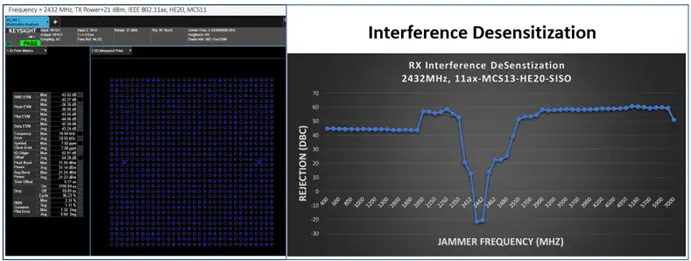
Every UAV deployment has unique communication requirements. That’s why Vizmonet offers customized RF communication, UAV connectivity, and wireless networking solutions tailored to mission-critical applications.
Need a custom solution for your drone or unmanned system project? Connect with our engineering team today.
FAQ: UAV Communication Systems
ke
What is a UAV communication system?
A UAV communication system enables secure data exchange between drones, ground control stations, sensors, and network infrastructure. It supports command and control, telemetry, video transmission, and mission-critical communications.
How do UAV communication links work?
UAV communication links use RF communication modules, antennas, telemetry systems, and networking technologies to maintain reliable connectivity between the aircraft and ground systems during flight operations.
What technologies enable long-range drone communication?
Long-range drone communication relies on advanced RF communication modules, directional antennas, mesh networking, LTE, 5G connectivity, and optimized telemetry systems to maintain stable communication over extended distances.
What is UAV connectivity and why is it important?
UAV connectivity refers to the ability of a drone to maintain reliable communication with operators, networks, and connected systems. Strong UAV connectivity is essential for flight safety, real-time data transmission, and autonomous operations.
What are secure drone communication systems?
Secure drone communication systems use encryption, authentication, anti-jamming technologies, and secure networking protocols to protect communications from interference and unauthorized access.