
Unmanned Aerial Systems – Reliable Connectivity
Vizmonet delivers carrier-grade connectivity solutions for Unmanned Aerial Systems (UAS), engineered to meet the stringent performance requirements of mission-critical drone operations. Our systems are purpose-built to enable deterministic, low-latency, and high-throughput communication across complex and interference-prone environments.
From industrial inspection and asset monitoring to disaster response and defense applications, Vizmonet’s wireless platforms ensure continuous command-and-control (C2) links, real-time data exchange, and operational integrity—even under adverse RF conditions.
At the core of these capabilities is Vizmonet’s Carrier-Class-Customized™ wireless architecture, designed to optimize link reliability, spectral efficiency, and system resilience across diverse UAV deployment scenarios.
What is Unmanned Connectivity in UAV Systems?
Unmanned connectivity refers to the end-to-end communication framework that enables UAVs to maintain stable and secure links with ground control systems, other aerial nodes, and backend infrastructure.
A robust UAV communication system typically integrates:
- High-Performance RF Transceivers
- Adaptive Wireless Protocols
- Network-Layer Redundancy Mechanisms
- Ground Control & Telemetry Interfaces
These systems support:
- Real-Time HD Video Transmission
- Telemetry & Sensor Data Streaming
- Precision Flight Control & Navigation
- Autonomous & Semi-Autonomous Mission Execution
In high-stakes operations, connectivity is not a supporting function — it is a primary system dependency.
UAV Networking Solutions & Communication Technologies
Modern UAS deployments require multi-layered networking architectures capable of sustaining reliable communication across dynamic topologies and challenging RF environments.
Vizmonet’s UAV networking solutions leverage a combination of advanced wireless communication technologies to ensure stable connectivity, low latency, and scalable network performance.
RF Mesh Networking
Enables decentralized, self-healing communication between UAV nodes and ground stations. This architecture enhances range, redundancy, and network survivability in distributed deployments.
Long-Range Wireless Communication
Optimized RF front-end design and link budgeting techniques allow for extended operational range while maintaining signal integrity and throughput.
Industrial Wi-Fi & High-Throughput Wireless Systems
Supports bandwidth-intensive payloads such as HD video, LiDAR, and multispectral imaging with deterministic latency characteristics.
Cellular Integration (LTE / 5G)
Provides extended coverage using public or private cellular infrastructure, particularly in urban and semi-urban environments.
Satellite Communication (SATCOM)
Ensures connectivity continuity in remote, offshore, or beyond-line-of-sight (BLOS) operations where terrestrial infrastructure is unavailable.
Operational Challenges in Drone Communication Systems
UAV communication systems operate under highly variable and often hostile RF conditions, where maintaining link stability is non-trivial.
Typical operational challenges include:
- RF Interference:
Congested spectrum environments degrade signal quality and increase packet loss. - Latency Sensitivity:
Control loops and video feedback require sub-second responsiveness. - Range Limitations:
Signal attenuation over distance impacts reliability in long-range missions. - Network Fragmentation:
Dynamic UAV movement introduces handover and routing complexities.
In applications such as industrial inspection, surveillance, and emergency response, link degradation directly impacts mission success and operational safety.
Vizmonet’s Approach to Reliable UAV Connectivity
Vizmonet addresses these challenges through a system-level engineering approach that combines RF design, protocol optimization, and network intelligence.
Key capabilities include:
- Interference Mitigation:
Advanced filtering, channel selection, and adaptive modulation techniques. - Low-Latency Communication:
Optimized data paths for real-time control and feedback. - Extended Coverage:
High-sensitivity receivers and optimized transmission power management. - Secure Communication:
Encryption and anti-jamming mechanisms for mission-critical environments.
The result is a robust and scalable communication backbone tailored for demanding UAV applications across industrial, defense, and enterprise deployments.
Key Features & Benefits
Engineered for Mission-Critical UAV Operations
- High-throughput links for LiDAR, telemetry, and HD video payloads
- Deterministic low-latency performance for precise flight control
- Consistent connectivity across heterogeneous environments
Go Beyond Limits with Drone Connectivity
- Drones excel in remote, hard-to-reach areas, where standard networks fall short
- Our mesh networking and long-range radios ensure coverage in:
- Offshore oil rigs and marine platforms
- Mountainous terrain and dense forests
- Large construction zones
- Emergency and disaster response sites
- Agricultural fields and isolated facilities
Clear Communication in Crowded Airspace
- Modern airspace is filled with Wi-Fi, cellular, and RF signals, creating high interference.
- This interference can reduce range, degrade signal quality, or cause complete loss of communication for UAS.
- Consistent connectivity is critical for control, safety, and mission success.
Interference-Resilient Solution
- Built for high-interference environments commonly faced by drones.
- Uses advanced technologies:
- Signal processing to filter out noise
- Dynamic frequency selection to avoid crowded channels
- Adaptive modulation to adjust to real-time conditions
- Ensures stable, reliable links between drones and ground control—even in noisy RF zones.
- Ideal for mission-critical operations where communication can’t fail.
Multi-Radio Redundancy
Multiple frequency paths ensure your drone stays connected—even in tough RF environments. If one link drops, another takes over instantly.
Built-In Encryption & Cyber Resilience
Protects critical data and control signals from interception, jamming, or hijacking.
In high-stakes missions—like defense, disaster relief, or infrastructure monitoring—secure communication is non-negotiable.
Seamless Handover Between Nodes
Maintains uninterrupted connectivity when drones move across zones or mesh network points.
Ensures smooth operations in dynamic environments like long-range inspections, mobile command setups, or sprawling industrial zones.
Edge-Processing Support
Enables real-time analysis and decision-making onboard the drone without needing cloud access.
Reduces latency, saves bandwidth, and is critical for autonomous missions where split-second decisions matter.
Mesh Radio Systems for UAV Connectivity
Vizmonet’s mesh-enabled wireless platforms provide a scalable and resilient networking framework for UAV operations.
Key advantages include:
- Self-forming and self-healing network topology
- Extended operational range through multi-hop communication
- High fault tolerance in dynamic deployment scenarios
These systems are particularly suited for:
- Multi-UAV coordination and swarm operations
- Large-area surveillance and inspection
- Defense and tactical communication networks
Frequently Asked Questions
What is unmanned connectivity?
It refers to the communication systems that enable UAVs to exchange data and maintain control links in real time.
How do UAV communication systems operate?
They use RF, Wi-Fi, mesh, or cellular networks to connect aerial platforms with ground control and backend systems.
What is mesh networking in UAV applications?
Mesh networking allows UAVs to act as network nodes, extending range and improving reliability through multi-hop communication.
What factors affect UAV communication performance?
RF interference, environmental conditions, transmission power, frequency selection, and network architecture all influence performance.
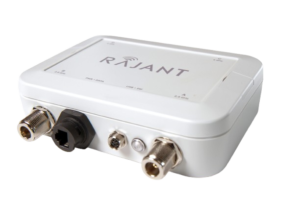
RAJANT Case Study ES1 Breadcrumb
Vizmonet led the hardware design effort, including circuit design and packaging, while continuously incorporating Rajant’s feedback from testing and validation..
Vizmonet was acting as Satellite R&D center for Rajant and worked closely with Rajant to manage the complete product life-cycle.
Vizmonet team worked with regulatory Labs to get the product approved for FCC/IC/CE and other geography specific homologation.

Related Products
BKP6-AX2AX2-2450 Wi-Fi 6
Explore the advanced features of BKP6-AX2AX2-2450 Wi-Fi6, offering robust 30 dBm output for seamless wireless networking.
BKP4-OD-N2N2-2450 Wi-Fi 4
High-Performance, Dual independent Radio operating in ISM 2.4 GHz (2×2 MIMO) license-free Band and 4.9 GHz (Public safety)
BKP-N2N2-2450 Wi-Fi 4
Highly linear transmitter design with an ultra-high TX power of 29 dBm adhering to strict EVM level exceeding requirements OFDM modulated signals.