
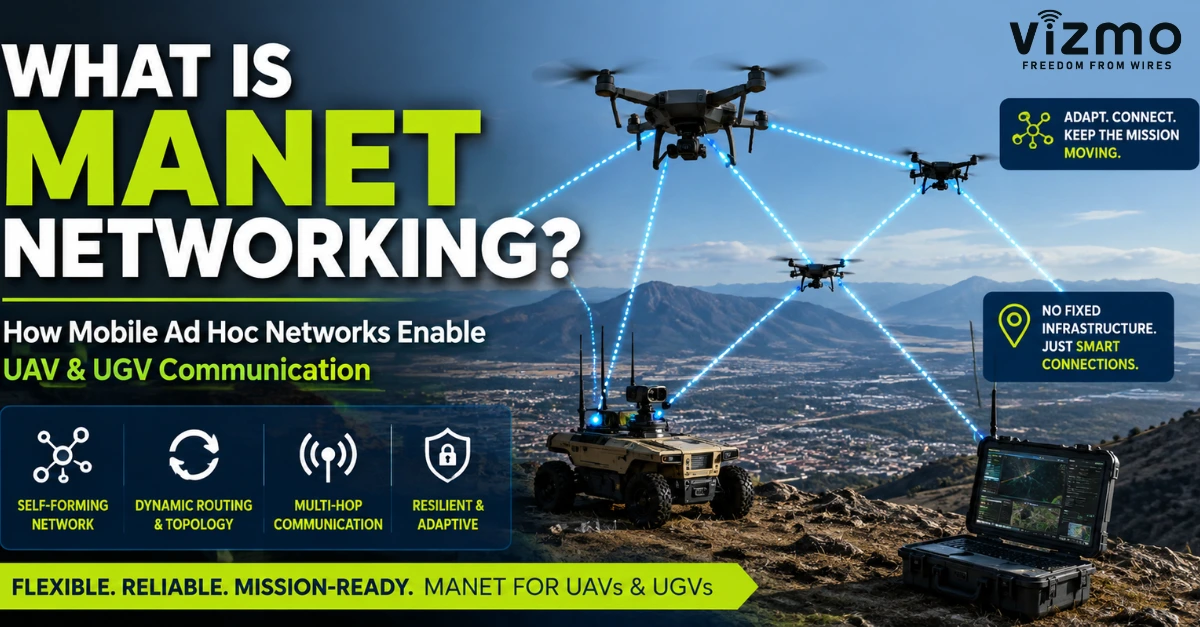
What Is MANET Networking? How Mobile Ad Hoc Networks Enable UAV & UGV Communication
A conventional wireless network usually assumes that something stays put.
A Wi-Fi access point remains fixed. A base station provides coverage over a defined area. A UAV talks directly to a ground station. A mobile robot stays connected as it moves through that coverage zone.
Unmanned systems do not always behave so conveniently.
A drone can disappear behind a building. A UGV can enter a tunnel or move behind industrial equipment. Several vehicles may spread out across an operating area while their relative positions keep changing. A radio path that worked seconds ago may no longer be the best route.
This is the type of problem MANET networking is designed to address.
A Mobile Ad Hoc Network allows mobile wireless nodes to form a network without depending entirely on fixed communication infrastructure. Nodes can communicate directly where possible and, depending on the routing architecture, forward traffic for other nodes across multiple wireless hops.
For UAV and UGV systems, that creates an important possibility: the network can adapt as the platforms themselves move.
What Is MANET Networking?
MANET stands for Mobile Ad Hoc Network. It is a wireless network formed by mobile nodes that can establish and maintain communication without requiring a fixed network infrastructure, while routes may change as the nodes move.
A participating node may be a UAV, UGV, vehicle, portable radio, robotic platform, sensor platform or other mobile system.
Instead of assuming that every device has a permanent connection to one central access point, a MANET can allow nodes to participate in the network’s routing function.
Consider a simple UAV network:
UAV A → UAV B → Ground Station
UAV A cannot currently maintain a useful direct link to the ground station, but UAV B can communicate with both. Traffic from UAV A may therefore be forwarded through UAV B.
Now imagine UAV B moves away while UAV C enters a better position.
The route might become:
UAV A → UAV C → Ground Station
That changing topology is one of the defining characteristics of a mobile ad hoc network.
The IETF’s Mobile Ad Hoc Networking guidance describes MANETs as autonomous groups of mobile nodes operating over dynamic, potentially rapidly changing, multihop wireless topologies.
The important words are mobile, dynamic and multihop.
Is MANET the Same as Mesh Networking?
Not exactly.
The terms overlap because both architectures can use multiple interconnected nodes and multi-hop forwarding. However, mobility is much more central to MANET design.
A conventional wireless mesh network may contain radio nodes mounted on buildings, poles, industrial machines or fixed infrastructure. Those nodes can provide alternative paths even though their physical positions rarely change.
A MANET must account for nodes that may move continuously.
| Network Type | Typical Infrastructure | Node Mobility | Multi-Hop Routing | Topology Change |
|---|---|---|---|---|
| Conventional infrastructure wireless | Access point or base station required | Clients may move | Usually not through client devices | Relatively predictable |
| Wireless mesh network | May be decentralized | Fixed or mobile | Common | Low to high depending on deployment |
| MANET | Fixed infrastructure not required for local network operation | Central characteristic | Common | Potentially frequent and rapid |
The distinction matters when engineers evaluate a network.
A routing strategy that works well between fixed industrial mesh nodes may perform differently when the same nodes are installed on aircraft or ground vehicles moving relative to one another.
For a broader explanation of node forwarding, multi-hop links and mesh topology, see Vizmonet’s guide to wireless mesh networking.
How Does a Mobile Ad Hoc Network Work?
A MANET needs more than radios that can hear one another.
The networking system must determine which nodes are currently reachable, how traffic should reach its destination and what should happen when a link disappears.
The exact implementation varies, but several functions are fundamental.
Node and Neighbor Awareness
A participating system needs some way to identify which other nodes are reachable through its wireless interfaces.
As vehicles move, the neighbor relationship can change.
A UAV that was within useful RF range a few seconds ago may move farther away. Another aircraft may move into a better position. A ground vehicle may pass behind an obstruction and lose one neighbor while gaining another.
The networking layer therefore works with information that can become outdated quickly.
Dynamic Route Selection
Traffic needs a path through the network.
If UAV A cannot directly reach the ground station but can reach UAV B, and UAV B can reach the ground station, the network may use UAV B as an intermediate forwarding node.
With more nodes, several potential routes may exist.
A routing system may consider factors such as:
- Current node reachability
- Hop count
- Link condition
- Route availability
- Network load
- Implementation-specific routing metrics
The best routing decision depends on the application and routing technology being used.
Multi-Hop Forwarding
Multi-hop communication allows a packet to cross more than one wireless link before reaching its destination.
For example:
UGV 1 → UGV 2 → UAV Relay → Ground Station
This can extend communication beyond the direct radio path available to an individual node.
But a longer route is not automatically a better route.
Each additional hop may introduce forwarding delay, consume airtime and create another link whose RF performance can affect the end-to-end connection.
Route Recovery
Mobility causes links to appear and disappear.
If an active path becomes unavailable, the network may identify another route when one exists.
For example:
Original route:
UAV A → UAV B → Ground Station
After UAV B moves behind terrain:
UAV A → UAV C → Ground Station
This adaptive behavior is sometimes described as self-healing.
The term should be used carefully. A MANET cannot create connectivity where no viable RF path exists. If all possible paths between two parts of the network are blocked, out of range or heavily interfered with, routing software alone cannot restore the connection.
Why MANET Networking Matters for UAV Communication
UAV networks combine several conditions that make conventional fixed-network assumptions difficult.
Aircraft move quickly. Altitude changes. Antenna orientation changes as the aircraft banks or turns. Structures, terrain and other vehicles can temporarily affect line of sight.
At the same time, a UAV may need to carry multiple types of traffic:
- Command and control
- Telemetry
- Navigation information
- Payload data
- Sensor information
- Video
- Diagnostics
In a single-UAV operation close to its ground station, a direct radio link may be entirely adequate.
The networking problem changes when several aircraft need to cooperate or operate beyond a reliable direct communication path.
MANET architecture can allow an aerial node to become part of the communication path for another node.
That makes MANET particularly relevant to multi-UAV operations, distributed inspection, temporary airborne communication networks and other deployments where the position of each radio changes throughout the mission.
Vizmonet’s existing guide to UAV networking solutions covers the wider use of mesh communication for drone systems.
How Can MANET Support UGV Communication?
Ground vehicles create a different RF problem.
A UGV usually operates much closer to surrounding obstacles than an aircraft. Buildings, machinery, containers, vehicles, earthworks and terrain can interrupt a direct wireless path.
Antenna height is also more constrained.
Consider several robotic vehicles working across a large industrial site.
UGV A may have a direct connection to the control station when it is in an open area. After moving behind a large structure, that link may weaken.
If UGV B remains in a position where it can communicate with both UGV A and another network node, a MANET architecture may provide an alternate multi-hop route.
The same principle can be useful in:
- Industrial inspection vehicles
- Mining robots
- Warehouse or logistics platforms
- Remote surveillance vehicles
- Heavy-equipment automation
- Emergency-response robotics
OEMs evaluating ground-platform requirements can also review Vizmonet’s Unmanned Ground Systems applications.
Example: A Mixed UAV and UGV Network
Consider an engineering team developing a system with three UAVs, two UGVs and a portable ground control station.
At the beginning of the mission, every vehicle can communicate directly with the ground station.
Later, the platforms separate.
One UGV moves behind a structure. A second travels farther into the operating area. One UAV climbs to a position where it can maintain useful links with both the ground station and the remote vehicles.
Instead of requiring every vehicle to maintain its original direct link, the network may form paths such as:
UGV 1 → UAV 2 → Ground Station
and:
UGV 2 → UGV 1 → UAV 2 → Ground Station
If UAV 2 moves out of position, another suitable node may become part of the route.
This illustrates the architectural value of MANET.
It also exposes the engineering challenge.
The radio system is no longer supporting one predictable point-to-point link. It is supporting several changing RF links, shared network capacity and routing decisions at the same time.
What Are the Main Engineering Challenges in MANET Systems?
MANET architecture can increase networking flexibility, but it does not remove RF or system-design constraints.
In many cases, it makes understanding them more important.
Rapidly Changing Topology
Mobility means network information can age quickly.
A route that was valid when calculated may become less useful as the nodes move. Higher vehicle speeds, greater node separation and obstructed environments can increase the frequency of network changes.
Routing behavior therefore needs to be evaluated using realistic movement patterns rather than only a static bench setup.
Routing Overhead
A MANET needs information about connectivity and routes.
Maintaining that information consumes processing resources and network capacity.
As node count and mobility increase, routing-control traffic may also increase depending on the protocol and implementation.
Engineers should therefore evaluate network scalability using the expected number of vehicles and realistic traffic patterns.
Latency Across Multiple Hops
Every hop involves another wireless transmission and forwarding operation.
A route containing several hops can therefore behave differently from a direct radio link.
This matters particularly for control traffic.
A network transporting command-and-control messages should be evaluated for end-to-end latency and variation under actual routing conditions rather than assuming that the latency specification of one radio link represents the complete network.
Shared Wireless Capacity
Multi-hop communication can consume additional airtime.
A packet received by an intermediate node may need to be transmitted again over the next link. Depending on the radio architecture, channel arrangement and traffic pattern, this can reduce the capacity available for application data.
High-rate video is especially important here.
A network carrying several simultaneous UAV video streams has very different capacity requirements from one carrying only telemetry.
RF Link Quality
Routing software cannot compensate for fundamentally poor RF design.
Each wireless hop still depends on parameters such as:
- Transmit power
- Receiver sensitivity
- Antenna gain
- Antenna orientation
- Cable and connector loss
- Frequency
- Channel bandwidth
- Interference
- Path loss
- Obstruction
- Multipath
A route with fewer high-quality links may perform better than a route containing several marginal RF links.
Antenna Orientation on Mobile Platforms
Antenna behavior is particularly important on UAVs and UGVs.
Aircraft orientation changes during manoeuvres. Ground vehicles can rotate, tilt or move alongside large reflective structures.
An antenna pattern that performs well while the platform faces one direction may behave differently after the vehicle changes orientation.
The antenna system should therefore be evaluated as part of the platform rather than as an isolated component.
Power and SWaP-C
Every airborne radio competes with propulsion, computing, sensing and payload systems for available power and weight.
UGVs usually have more energy available than small UAVs, but power consumption and heat remain important design constraints.
Engineers need to consider the complete communication subsystem:
Radio + processor + antennas + RF cables + mechanical hardware + thermal solution + software
not only the radio-module weight.
Interference
A MANET does not operate in an RF vacuum.
Industrial sites, urban environments and emergency-response areas may contain Wi-Fi networks, video systems, telemetry equipment and other radios.
Interference can affect individual links and therefore change which routes remain usable.
Channel planning and spectrum assessment should be performed alongside routing evaluation.
Security
Decentralized networking creates additional security questions.
Engineering teams should determine:
- Which nodes are allowed to join
- How participating nodes authenticate
- How encryption keys are managed
- Whether forwarded traffic is protected
- How compromised nodes are isolated
- How network-management interfaces are secured
- What happens when a node is lost or physically captured
Security needs to be designed into the network architecture rather than added after routing has been implemented.
MANET Is a Networking Architecture, Not a Radio Frequency
This distinction is important when selecting hardware.
MANET does not itself specify that a system must operate at 900 MHz, 2.4 GHz, 4.9 GHz or 5 GHz.
It is also not synonymous with Wi-Fi, Wi-Fi HaLow or any single RF technology.
The radio technology provides the underlying wireless links. MANET routing and network-management functions determine how participating nodes use those links to communicate across a changing topology.
This means two engineering questions need separate answers:
Can the radio link meet the RF requirements?
and:
Can the networking system maintain the required routes as the nodes move?
A successful unmanned communication system needs both.
How Should OEMs Evaluate Wireless Hardware for MANET Platforms?
Selecting a wireless module for a mobile ad hoc system requires looking beyond peak data rate.
Start with the application.
How many vehicles will participate? How fast do they move? What distance separates them? How much traffic does each node generate? Is the network carrying telemetry, control data, video or all three?
Then evaluate the radio platform.
Important factors include frequency support, RF output, receive performance, software environment, physical interfaces, antenna options, operating temperature, power consumption, thermal design and mechanical integration.
Software access can also matter because custom networking architectures may require control over routing, monitoring, firewall rules, interfaces and network diagnostics.
For teams evaluating high-throughput hardware for autonomous platforms, Vizmonet’s guide to industrial Wi-Fi 6 modules for UAVs and UGVs covers these hardware-level considerations in more detail.
Where BlackPepper 6 Can Fit in the Hardware Architecture
Vizmonet’s BlackPepper 6 BKP6-AX2AX2-2450 Wi-Fi 6 module is an embedded wireless platform that OEMs can evaluate for UAV, UGV and other industrial communication systems.
The module supports dual independent 2×2 MU-MIMO radios, 2.4 GHz, 4.9 GHz and 5 GHz operation, Linux/OpenWrt and the ath11k driver.
Those capabilities provide developers with a configurable wireless hardware platform.
They should not, however, be interpreted as an automatic MANET implementation.
The final system still requires appropriate routing software, network configuration, RF design, security architecture and validation under realistic node movement.
That distinction is important during prototype evaluation.
A radio can perform very well in a static point-to-point test while the complete mobile network still encounters route convergence, congestion, antenna or interference problems during field operation.
When MANET May Not Be the Right Architecture
MANET adds flexibility, but that flexibility comes with complexity.
A simpler architecture may be preferable when:
- Every node can maintain a reliable direct connection to fixed infrastructure
- The deployment contains only one or two mobile platforms
- Topology changes are minimal
- Very high aggregate throughput is required over a constrained shared channel
- Deterministic end-to-end timing cannot tolerate route changes
- Nodes are too widely separated to provide useful intermediate links
- Network management needs to remain extremely simple
For a fixed industrial site, a conventional infrastructure network or relatively static mesh system may be easier to design and operate.
For a single UAV operating within reliable ground-station coverage, a direct link may also be the cleaner solution.
Use MANET because mobility and dynamic connectivity create a real networking requirement—not simply because multi-hop communication is available.
MANET Design Checklist for UAV and UGV OEMs
Before selecting the radio or routing architecture, define:
- ☐ Number of UAVs, UGVs and ground nodes
- ☐ Maximum and typical distance between nodes
- ☐ Expected node speed and movement pattern
- ☐ Required frequency bands
- ☐ Deployment-country spectrum restrictions
- ☐ Command-and-control latency requirements
- ☐ Telemetry data rate
- ☐ Video and payload-data requirements
- ☐ Maximum acceptable number of hops
- ☐ Required route-recovery behaviour
- ☐ Network scalability requirements
- ☐ Interference environment
- ☐ Antenna type, placement and orientation
- ☐ Available electrical power
- ☐ Size and weight limits
- ☐ Thermal constraints
- ☐ Environmental operating requirements
- ☐ Host interfaces
- ☐ Linux/OpenWrt or other software requirements
- ☐ Authentication and encryption architecture
- ☐ Ground-station and gateway requirements
- ☐ Prototype field-test plan
The checklist should be completed at system level. Selecting the radio first and defining the networking requirements later often forces avoidable compromises.
Frequently Asked Questions
What does MANET stand for?
MANET stands for Mobile Ad Hoc Network. It describes a network of mobile wireless nodes that can communicate without depending entirely on fixed networking infrastructure and may forward traffic through other participating nodes.
How is MANET different from a normal wireless network?
A conventional wireless network usually relies on fixed infrastructure such as an access point or base station. A MANET can form among mobile nodes themselves, and network routes may change as those nodes move.
Is MANET the same as a mesh network?
No. The concepts overlap, particularly because both can use multi-hop forwarding. A mesh network may consist largely of fixed nodes, while MANET design specifically addresses mobile nodes and changing topology.
Why is MANET useful for drones?
MANET can allow UAVs to communicate through other participating nodes when a direct path is unavailable or when several aircraft need to form a distributed network. Actual performance still depends on RF coverage, routing behaviour, network capacity and system design.
Can UAVs and UGVs operate in the same MANET?
Potentially, yes. A properly designed network can include different mobile platforms, provided the radios, networking software, addressing, security and routing architecture are compatible.
Does MANET automatically increase communication range?
No. MANET can extend network reach by forwarding traffic through intermediate nodes when suitable links exist. It does not increase the physical RF range of an individual radio link.
Does a Wi-Fi module automatically support MANET?
Not necessarily. A wireless module provides the radio and networking hardware capabilities. MANET functionality depends on the networking software, routing implementation, configuration and complete system architecture.
Building a MANET for a Real UAV or UGV Platform
MANET networking becomes valuable when mobility changes the network itself.
The objective is not simply to connect several radios. The system must maintain useful communication while node positions, RF conditions and available routes change.
That requires coordinated decisions across RF engineering, antennas, routing, software, power, thermal design, security and mechanical integration.
OEMs developing Unmanned Aerial Systems or unmanned ground platforms should therefore evaluate the complete communication architecture before committing to hardware.
Vizmonet’s wireless engineering services can support OEM teams evaluating RF architecture, wireless hardware integration, antenna design, product development and manufacturing requirements.
Discuss Your UAV or UGV Communication Requirements
If you are evaluating wireless hardware for a UAV, UGV or another mobile platform, define the project requirements before selecting the communication architecture.
Useful information to prepare includes:
- Application and vehicle type
- Number of network nodes
- Required operating range
- Target frequency bands
- Telemetry and payload-data requirements
- Command-and-control requirements
- Host processor and operating system
- Available power
- Antenna constraints
- Environmental requirements
- Deployment countries
- Expected production volume
With those inputs, the RF and networking architecture can be evaluated against the actual mission rather than a generic radio specification.