
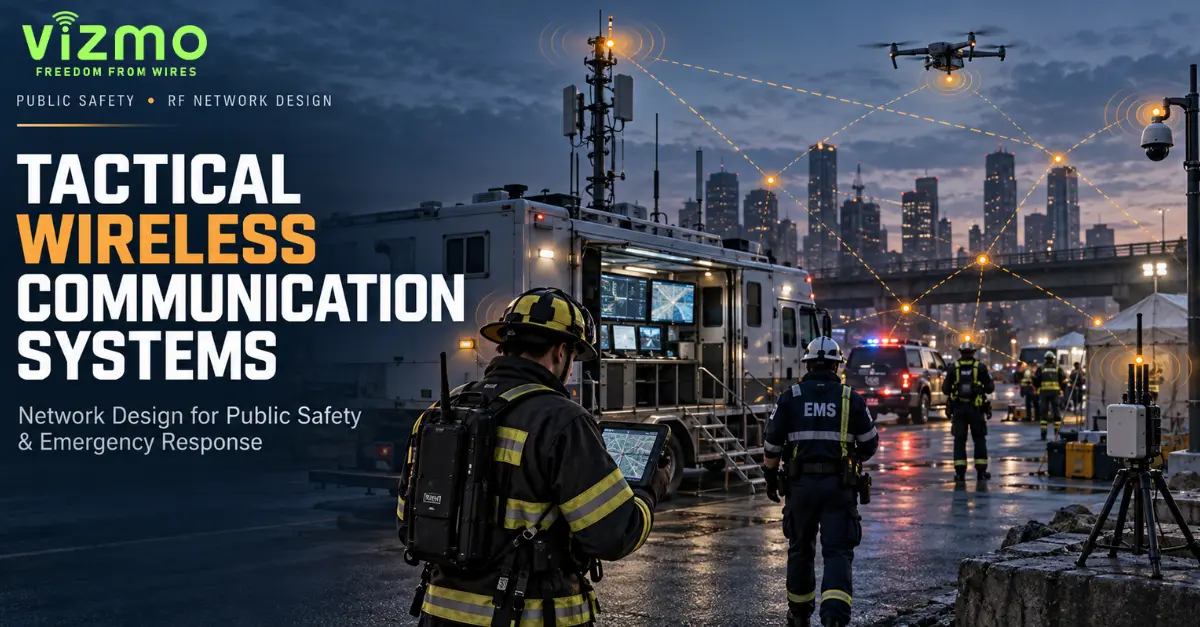
Tactical Wireless Communication Systems: Network Design for Public Safety and Emergency Response
A wireless network that works well during normal operations can face very different conditions during a major emergency.
Fixed infrastructure may be damaged. Commercial networks can become congested. Emergency vehicles, command posts, cameras, drones, sensors, and response teams may enter and leave the operating area continuously. Buildings, terrain, moving vehicles, and other radio systems can also change the RF environment from one minute to the next.
This is why tactical wireless communication needs to be designed as a complete network rather than as a collection of radios.
For public safety and emergency response systems, engineers need to consider network topology, RF coverage, redundancy, traffic priorities, spectrum, antennas, security, power, environmental conditions, and interoperability together.
Vizmonet supports wireless systems used across public safety applications, including communication platforms that require reliable connectivity in demanding field environments.
What Is Tactical Wireless Communication?
Tactical wireless communication is a rapidly deployable wireless network architecture designed to maintain communication between field personnel, vehicles, sensors, command systems, and other operational assets under changing or infrastructure-limited conditions.
In a public safety environment, the term “tactical” does not refer to one specific radio technology or frequency band.
A tactical communication network may combine several communication technologies, including:
- Land Mobile Radio systems
- Public safety broadband or cellular connectivity
- Local Wi-Fi networks
- Point-to-point wireless links
- Point-to-multipoint networks
- Mesh networks
- Mobile ad hoc networks
- Temporary wireless access points
- Vehicle-mounted communication gateways
- Microwave backhaul
- Satellite backhaul
- Fiber or wired connections where available
The engineering objective is not to select one universally superior radio technology.
The objective is to create a communication architecture capable of keeping essential information moving when individual links, network nodes, or infrastructure become unavailable.
Why Emergency Response Networks Are Difficult to Design
Emergency response networks can operate under conditions that conventional enterprise wireless systems may never experience.
Consider an incident involving fire departments, law enforcement, emergency medical teams, utilities, and emergency management organizations.
Within a relatively small geographic area, the network may need to support:
- Portable radios
- Emergency vehicles
- Mobile command units
- Body-worn cameras
- Fixed surveillance cameras
- Mobile cameras
- UAVs and drones
- Rugged laptops
- Tablets
- Environmental sensors
- Temporary communication gateways
- Cellular networks
- Existing Wi-Fi networks
- Other public safety radio systems
Every additional device changes the network load and potentially changes the RF environment.
A network architecture that performs well during a controlled laboratory test may therefore behave differently when deployed among buildings, vehicles, interference sources, terrain obstacles, and large numbers of users.
A Practical Tactical Wireless Network Architecture
A useful approach to tactical wireless network design is to divide the system into multiple communication layers.
Field Edge
Typical components:
- Cameras
- Sensors
- Portable terminals
- UAVs
- Body-worn systems
- Rugged mobile devices
Primary functions:
- Collect operational information
- Generate telemetry
- Capture video
- Provide user access to the network
Local Access Network
Typical technologies:
- Wi-Fi
- Mesh networking
- Mobile radios
- Vehicle networks
- Portable access points
Primary function:
- Connect field assets within the emergency or incident area
Incident Gateway
Typical components:
- Command vehicle
- Portable communication gateway
- Edge computing system
- Network router
Primary functions:
- Aggregate field traffic
- Manage local network communication
- Connect the incident network to external backhaul
Backhaul Network
Possible technologies:
- Cellular
- Public safety broadband
- Point-to-point wireless
- Satellite
- Microwave
- Fiber
Primary function:
- Connect the incident network to remote command infrastructure
Command and Core Network
Typical systems:
- Emergency Operations Center
- Dispatch systems
- Cloud platforms
- Monitoring systems
- Central databases
Primary functions:
- Operational coordination
- Data processing
- Communication management
- Monitoring
- Incident response
Separating the system into layers makes failure analysis easier.
Engineers can ask questions such as:
- What happens if primary internet connectivity disappears?
- Can the local incident network continue operating?
- What happens if one wireless access point fails?
- Can users automatically connect through another node?
- What happens if the command vehicle changes location?
- Can the network topology adapt?
- Is alternate backhaul available?
These questions should be answered during network architecture development rather than during an emergency.
1. Define the Mission Before Selecting the Radio
Tactical wireless network design should begin with operational requirements.
Engineers first need to understand what information the system must transport and what happens when that information is delayed or lost.
For example, a network transporting occasional sensor readings has very different requirements from a network carrying several simultaneous HD video feeds.
Define the following requirements before selecting wireless hardware:
- Number of users
- Number of wireless nodes
- Typical operating distance
- Maximum expected distance
- Fixed or mobile nodes
- Vehicle mobility
- UAV mobility
- Voice communication requirements
- Command-and-control traffic
- Telemetry requirements
- Video traffic
- File transfers
- Mapping applications
- Acceptable latency
- Required network availability
- Deployment duration
- Backhaul availability
- Operating environment
These requirements determine what the wireless network actually needs to accomplish.
2. Choose the Network Topology Around Mobility and Failure Modes
Network topology determines how wireless nodes exchange information and what happens when a communication path becomes unavailable.
Point-to-Point Wireless Networks
A point-to-point link is useful when two known locations require a dedicated wireless connection.
Examples include:
- Incident command post to remote communication site
- Building-to-building communication
- Temporary tower-to-command-center connection
- Remote surveillance site backhaul
Point-to-point systems can provide predictable communication paths.
However, a single point-to-point link can become a single point of failure unless another communication path is available.
Point-to-Multipoint Networks
A central wireless node can provide connectivity to multiple field devices or remote sites.
Possible applications include:
- Command vehicle connecting several remote units
- Temporary access point serving multiple teams
- Base station connecting multiple field sensors
- Central gateway communicating with distributed cameras
This architecture can be comparatively straightforward.
However, the central node becomes important to overall network availability.
Mesh and Mobile Ad Hoc Networking
When wireless nodes move and fixed infrastructure cannot be assumed, mesh or mobile ad hoc networking may allow traffic to use alternative paths through participating nodes.
For mobile systems, Vizmonet’s MANET networking guide explains how communication routes can change as wireless nodes move.
Mesh networking should not automatically be considered the best architecture for every tactical network. Additional wireless hops can affect:
- Network capacity
- Latency
- Routing complexity
- RF interference
- Network management
- Overall system performance
Engineers comparing architecture options can also review Point-to-Point Wireless vs Mesh Networks.
3. Design for Multiple Communication Paths
Resilience is one of the most important characteristics of a tactical wireless communication system.
The network should be evaluated against realistic failure scenarios.
- Loss of terrestrial internet connectivity
- Failure of one wireless access point
- Failure of a vehicle-mounted gateway
- Cellular network congestion
- Loss of cellular coverage
- Interference on the primary RF channel
- Power failure
- Antenna damage
- RF cable failure
- Connector failure
- Relay node moving outside usable coverage
- Environmental damage
Where mission requirements justify redundancy, the architecture may include:
- Multiple wireless access nodes
- Alternative frequency bands
- Multiple backhaul technologies
- Secondary cellular connections
- Satellite backup
- Alternate wireless routes
- Redundant power systems
Redundancy should also be tested under realistic operating conditions.
For example, adding a secondary satellite connection provides limited benefit if the routing architecture does not automatically switch traffic when the primary backhaul fails.
4. Calculate the RF Link Before Deployment
A radio specification alone cannot determine whether a tactical wireless link will perform reliably in the field.
The complete RF communication path needs to be evaluated.
A simplified RF link budget includes:
- Transmit power
- Transmit antenna gain
- RF cable losses
- Connector losses
- Free-space path loss
- Propagation losses
- Receive antenna gain
- Receiver sensitivity
- System losses
- Required fade margin
Vizmonet’s RF link budget calculation guide explains these relationships in greater detail.
Engineers can also use the Vizmonet RF Link Planner to evaluate parameters such as:
- Path loss
- Transmit power
- Antenna gain
- Received signal level
- Receiver sensitivity
- Link margin
Link-budget calculations should then be validated with field testing.
Real-world performance can be affected by:
- Buildings
- Vehicles
- Terrain
- Trees and foliage
- RF interference
- Antenna orientation
- Weather conditions
- Installation height
- Local noise floor
5. Treat Antennas as Part of the Network
A high-performance radio can still produce a poor wireless link when the antenna system is badly integrated.
Tactical platforms can create particularly difficult antenna conditions.
For example:
- Vehicles may contain several transmitters
- Portable gateways may have limited antenna separation
- UAVs continuously change orientation
- Temporary command equipment may be installed in non-ideal locations
- Metal structures may affect antenna radiation patterns
Engineers should evaluate:
- Antenna gain
- Radiation pattern
- Antenna polarization
- Antenna height
- Mechanical placement
- RF cable length
- Cable loss
- Isolation between radios
- Nearby conductive structures
- Vehicle body effects
- Platform movement
- Antenna orientation
Antenna performance should therefore be validated on the finished platform rather than only on a development or evaluation board.
6. Plan for Interference and RF Coexistence
Emergency scenes can quickly become dense RF environments.
Multiple organizations may operate communication equipment simultaneously, including:
- Police
- Fire departments
- Emergency medical services
- Utility companies
- Transportation departments
- Government agencies
- Private communication networks
- Commercial cellular networks
- Local Wi-Fi networks
Multiple radios may also be installed inside the same vehicle or equipment enclosure.
Possible RF problems include:
- Co-channel interference
- Adjacent-channel interference
- Receiver desensitization
- Insufficient antenna isolation
- High local noise floor
- Unplanned channel reuse
- Interference from nearby transmitters
Increasing transmit power does not solve every interference problem.
Network engineers may also need to consider:
- Channel planning
- Receiver performance
- Filtering
- Antenna separation
- Frequency coordination
- RF shielding
- Network architecture
7. Match Network Capacity to Operational Traffic
Modern public safety networks increasingly transport much more than voice.
A tactical network may simultaneously carry:
- Command traffic
- Location information
- GPS data
- Sensor telemetry
- Mapping data
- Database access
- Still images
- Live video
- UAV payload data
- Large file transfers
Video can be particularly demanding because several simultaneous video streams can consume substantial network capacity.
Engineers should therefore evaluate useful application throughput rather than relying only on the theoretical PHY data rate listed in radio specifications.
Vizmonet’s Radio Performance Metrics: Range vs Throughput article explains why headline radio specifications do not directly represent usable application performance.
8. Prioritize Traffic According to Mission Requirements
Not every packet has the same operational importance.
Some applications can tolerate delays while others require low latency and predictable delivery.
Command and Operational Control
- Low latency
- Reliable delivery
- Predictable network behavior
Voice Communication
- Low latency
- Continuity
- Stable connectivity
Telemetry and Location Data
- Reliable periodic updates
- Low to moderate bandwidth
- Consistent connectivity
Live Video
- High sustained capacity
- Stable throughput
- Network load management
Bulk File Transfers
- High capacity when available
- Greater tolerance for delay
Network architecture should identify these different traffic classes and define how the system behaves when network congestion occurs.
9. Where Does 4.9 GHz Fit in Public Safety Networks?
Frequency selection is another system-level decision.
In the United States, the 4940–4990 MHz band is associated with public safety communication and is regulated by the Federal Communications Commission.
OEMs developing public safety equipment for this band should verify current regulatory requirements before finalizing system design.
Important considerations include:
- Deployment country
- Licensing requirements
- Permitted frequencies
- Permitted channels
- Transmit power limits
- EIRP limits
- Channel bandwidth
- Interference environment
- Propagation requirements
- Antenna requirements
- Product certification strategy
The important engineering point is that a frequency band should not be selected only because a wireless module technically supports it.
OEMs specifically evaluating 4.9 GHz wireless hardware can review Vizmonet’s guide to choosing a 4.9 GHz industrial Wi-Fi module for first responder systems.
10. Security Must Be Designed Into the Network Architecture
A tactical wireless network may carry operationally sensitive information while using mobile nodes, temporary infrastructure, and multiple communication paths.
Security therefore needs to be considered from the beginning of the system design.
Engineering teams should define:
- Device authentication
- User authentication
- Encryption requirements
- Encryption key management
- Secure boot where required
- Device integrity
- Network segmentation
- Management-interface protection
- Logging
- Network monitoring
- Response procedures for lost devices
- Response procedures for compromised equipment
- Firmware update procedures
- Software update procedures
Mesh or distributed architectures create an additional question: which wireless nodes should be allowed to participate in routing or forward traffic for other devices?
That decision should be controlled rather than assumed.
11. Power and Environmental Design Matter in the Field
Emergency communication equipment may operate from:
- Vehicle power
- Batteries
- Portable generators
- Temporary power systems
- Backup power systems
Network availability therefore depends on more than RF coverage.
Designers should consider:
- Power consumption under realistic traffic loads
- Peak power requirements
- Battery runtime
- Backup power
- Thermal behavior
- Operating temperature
- Environmental protection
- Ingress protection where applicable
- Shock
- Vibration
- Connector durability
- RF cable protection
- Antenna protection
A network node that loses power after two hours is still a network failure even if its RF performance is excellent.
12. Design for Rapid Deployment
Emergency communication networks often need to be established where fixed communication infrastructure is unavailable, damaged, overloaded, or insufficient.
Rapidly deployable communication systems may therefore need to minimize:
- Manual RF configuration
- Complex network configuration
- Specialized installation procedures
- Unnecessary antenna alignment
- Dependence on fixed infrastructure
- Long startup procedures
- Complicated network discovery
After deployment, operators should also have a clear method for confirming that:
- Local connectivity is working
- Backhaul is available
- Redundant communication paths are functioning
- Network nodes are online
- Signal levels are acceptable
- Critical applications can communicate
Example: Temporary Wireless Network at an Emergency Incident
Consider an engineering team developing a deployable communication platform for a large emergency response site.
A portable or vehicle-mounted command node arrives first.
Nearby responder terminals, cameras, and sensors connect to the local wireless network.
Mobile relay nodes may be positioned around the operating area to extend connectivity around buildings, terrain, or other obstacles.
The command node then connects the local incident network to a remote Emergency Operations Center using the best available backhaul connection.
The primary route might use:
- Public safety broadband
- Commercial cellular connectivity
- Dedicated terrestrial backhaul
- Point-to-point wireless
A secondary backhaul connection could use:
- Another cellular provider
- Satellite communication
- Microwave
- Alternative RF connection
Now suppose a large building blocks the direct wireless path to one part of the operating area.
If the network architecture includes properly designed relay or mesh capabilities, an alternative communication route may keep those field devices connected.
However, this only works if:
- RF links have sufficient link margin
- Routing reacts correctly
- Alternate paths remain within coverage
- The secondary route has enough network capacity
- Interference remains manageable
This demonstrates why tactical communication must be engineered as a complete network rather than evaluated radio by radio.
The Wireless Module Is Only One Layer
OEMs building public safety gateways, command systems, emergency response platforms, and vehicle communication equipment still need suitable RF hardware.
However, a wireless module alone does not create a tactical communication network.
The finished system may also require:
- Host processor
- Routing software
- Network management software
- Antennas
- RF cables
- Power architecture
- Thermal management
- Mechanical integration
- Security architecture
- Backhaul integration
- Regulatory validation
For embedded platforms requiring 4.9 GHz and 5 GHz Wi-Fi capability, engineers can evaluate products such as the Vizmonet axE2-4950 Wi-Fi 6 Mini PCIe Module and the Vizmonet axE4-4950 Wi-Fi 6 Mini PCIe Module.
The correct wireless module depends on the host platform, frequency requirements, antenna architecture, network capacity, power requirements, thermal constraints, mechanical constraints, operating environment, and target regulatory market.
Tactical Wireless Network Design Checklist
Before finalizing the communication architecture, engineering teams should be able to answer the following questions:
- What is the primary operational mission?
- How many users are expected?
- How many wireless nodes are required?
- Which nodes are fixed?
- Which nodes are mobile?
- What voice traffic must be supported?
- What telemetry traffic must be supported?
- What video traffic must be supported?
- What data traffic must be supported?
- What latency is acceptable?
- What frequency bands can legally be used?
- What communication distance must be supported?
- Has an RF link budget been calculated?
- What fade margin is required?
- Where will antennas be positioned?
- What interference sources are expected?
- Should the topology be point-to-point, point-to-multipoint, mesh, or hybrid?
- What happens when one wireless node fails?
- What happens when primary backhaul disappears?
- Is secondary backhaul required?
- How will network traffic be prioritized?
- How will devices authenticate?
- How will communication be encrypted?
- How will encryption keys be managed?
- What power sources are available?
- What backup power is available?
- What operating temperatures must be supported?
- What environmental conditions must the system withstand?
- How quickly must the network be deployable?
- How will network health be monitored?
- What field-testing scenarios will be performed?
- What regulatory approvals will the finished system require?
How Vizmonet Supports Public Safety Wireless System Development
Tactical wireless communication systems bring together RF engineering, embedded hardware, antennas, software, networking, mechanical integration, certification, and manufacturing.
Vizmonet’s RF and wireless engineering services support OEMs developing industrial and mission-critical wireless products across these connected engineering disciplines.
Depending on the project, engineering support can include:
- Wireless system architecture evaluation
- RF engineering
- Wireless module integration
- Embedded wireless product development
- Antenna and RF integration
- Prototype development
- Wireless performance testing
- Regulatory preparation
- Product manufacturing support
For public safety platforms, the important objective is to evaluate the complete communication system against the intended operational environment rather than selecting individual components independently.
Frequently Asked Questions
What Is Tactical Wireless Communication?
Tactical wireless communication is a rapidly deployable communication architecture designed to connect field personnel, vehicles, sensors, command systems, and other operational assets in changing or infrastructure-limited environments.
What Is the Difference Between Tactical Communication and Normal Wi-Fi?
Normal Wi-Fi typically operates around relatively predictable infrastructure, coverage areas, and user locations.
Tactical communication may need to function while:
- Network nodes move
- Infrastructure fails
- Network topology changes
- RF interference increases
- Users move between coverage areas
- Alternative communication paths become necessary
Is a Tactical Wireless Network Always a Mesh Network?
No. Tactical networks can use:
- Point-to-point
- Point-to-multipoint
- Mesh
- Mobile ad hoc networking
- Cellular
- Satellite
- Wired communication
- Hybrid architectures
The appropriate topology depends on mobility, coverage, capacity, latency, redundancy, and deployment requirements.
Why Is Redundancy Important in Emergency Communication?
Emergency networks may operate when normal communication infrastructure is damaged, unavailable, overloaded, or congested.
Redundant communication paths reduce dependence on one:
- Access point
- Wireless node
- Radio link
- Cellular network
- Backhaul technology
- Power source
Is 4.9 GHz Used for Public Safety Communication?
The 4940–4990 MHz band is used for public safety-related communication in the United States under FCC regulations.
However, frequency availability, licensing requirements, and operating conditions vary by country and jurisdiction. OEMs must verify regulatory requirements for each intended deployment market.
What Should Engineers Evaluate Before Selecting a Wireless Module for a Tactical System?
Engineers should evaluate:
- Required frequency bands
- Link distance
- Network throughput
- Latency
- Host interface
- Antenna requirements
- Network topology
- Power consumption
- Thermal conditions
- Mechanical constraints
- Operating environment
- Software requirements
- Security requirements
- Regulatory market
Can Vizmonet Support OEM Public Safety Wireless Product Development?
Vizmonet provides RF and wireless engineering services for OEM wireless products.
Support can include RF engineering, wireless system development, embedded wireless integration, product development, testing, regulatory preparation, and manufacturing support.
Build the Network Around the Mission
Reliable tactical wireless communication is not created by simply choosing the radio with the highest transmit power or the largest advertised data rate.
It comes from designing the complete network around the mission.
Engineers need to understand:
- Where users will operate
- How network nodes will move
- What information must remain available
- Which communication links are most likely to fail
- How alternative routes will be established
- What spectrum can legally be used
- How the system will behave under realistic RF conditions
- What happens when normal infrastructure becomes unavailable
The radio, antennas, routing architecture, backhaul, power system, software, and security design must work together.
That system-level approach is particularly important for public safety and emergency response equipment, where operating conditions can change faster than the communication infrastructure around it.
Discuss Your Tactical Wireless Communication Requirements
Developing a public safety gateway, mobile command system, emergency response communication platform, or other mission-critical wireless product?
Before discussing the project, it can help to prepare:
- Required frequency bands
- Expected operating range
- Throughput requirements
- Traffic types
- Host platform
- Antenna constraints
- Network topology
- Environmental conditions
- Deployment countries
- Expected production volume